Thursday, 31 March 2011
Gad Saad - The Consuming Instinct (TEDxConcordia)
Marketing prof Gad Saad discusses the biological and evolutionary roots of our consuming instinct.

 TraffickingEnd
 The US Govt. spends more per day in the war on drugs than they do the entire year on the War on #trafficking
Andy Votel and Jane Weaver's Europium Alluminate Mix
Andy Votel and Jane Weaver have brewed a magical blend of spectral, eldritch, female-centric folk called Europium Alluminate. Its tracklist (damnably AWOL, as is common with many Votel-helmed mixes) emanates from a time when irony in music was mostly unconscionable. The prevalent doe-eyed sincerity is positively touching and the gentle sonic strangeness utterly charming. Download the mix for free here.
The clip below gives you an idea of Weaver's aesthetics(!)
Dave Segal @'Line Out'
The clip below gives you an idea of Weaver's aesthetics(!)
Dave Segal @'Line Out'
A day with deadmau5: LEDs, Super Mario, and techno

The first thing we asked Joel was what came first: the tech or the music? He told us that they both kind of came together, but that he was first a techie. He started producing chiptune tracks at age fifteen (which happens to be a genre quite familiar to a certain unnamed podcast), and served as the technical person at a dance radio station in Canada in his late teens. Thus, it makes sense that his productions are technologically advanced, and that's most certainly the case of the most recent edition. The main setup consists of the LED cube and helmet, which are both linked together on one main server via Ethernet...

Continue reading
Jacob Schulman @'engadget'
 AJELive
 US military: Coalition jet fighters have so far flown 784 sorties over #Libya. The US: 1206. More at #AlJazeera: http://aje.me/hwGxvv #feb17
Listen to Panda Bear's DJ Set for NPR
 Photo by Brian DeRan
MP3: Panda Bear: "Last Night at the Jetty"
Panda Bear recently did some time in the NPR studios with All Songs Considered host Bob Boilen. He played and discussed a few cuts from his forthcoming solo album Tomboy (out April 12 on Paw Tracks), "You Can Count on Me", "Slow Motion", and "Last Night at the Jetty" (the latter of which you can also check out above). He also spun music from folks like Nirvana, Zomby, and fellow Animal Collective bandmate Avey Tare. Head here to listen to the whole thing.
Larry Fitzmaurice @'Pitchfork'


Arve Henriksen - Cartography Live, Molde Jazzfestival, Bjørnsonhuset, NO 2009-07-13

01 "Poverty And Its Opposite"
02 "Before And Afterlife"
03 "Migration"
04 "From Birth"
05 "Ouija"
06 "Recording Angel"
07 "Assembly"
08 "Loved One"
09 "The Unremarkable Child "
10 "Famine’s Ghost "
11 "Thermal" (ft. David Sylvian)
12 "Sorrow And Its Opposite"
Arve Henriksen: Trumpet, Electronics, Vocal
Helge Andreas Norbakken: Percussion
Jan Bang: Live Sampling
Eivind Aarset: Guitar, Electronics
Arve Henriksen is a classically trained musician whose ethereal, Japanese-influenced trumpet playing has literally placed him in a league of his own. He was born in Stranda, Norway, and educated at the Trondheim Conservatory. It was during his time at the conservatory that a friend gave Henriksen a tape recording of the shakuhachi flute. Henriksen was hooked. "I let the music 'ring' and develop in my head," he said. "I was astonished by the sound of this flute." His interest in minimalist Japanese music went on to have a profound effect on his trumpet playing and his music career. Henriksen went on to collaborate with numerous musicians on avant-garde, minimalist, and Eastern-influenced music, working with artists such as Anders Jormin, Edward Vesala, and the Source, before striking out on his own with 2001's Sakuteiki. He is also the trumpter of the improvisational jazz terror group Supersilent. Several more albums followed over the years, including 2004's critically acclaimed Chiaroscuro and 2007's Strjon (Margaret Reges)
Wednesday, 30 March 2011
astrangelyisolatedplace - Reflection on 2010

01. 36 - Geiga
02. Nest - Charlotte
03. Mig Dfoe - Real de 14
04. Ous Mal - Marraskuu
05. Loscil - Fern and Robin
06. bvdub - No One Will Ever Find You Here
07. Pantha Du Prince - Im Bann
08. Thomas Fehlmann - Falling Into Your Eyes
09. Elika - Stand Still
10. Ulrich Schnauss + Manual - In Odense
11. Solar Fields - Unite
12. Stellardrone - Milliways
13. Dalot - XX
14. D_rradio - Midnight on a Moonless Night
15. Horizon Fire - Denver River Logging
16. Foxes in Fiction - Karma Bank
17. Rhian Sheehan - Texture 2
18. Casino Versus Japan - Hello You
19. Verulf - Sunlight and Sea
20. Dextro - Ring Cycle (Live version)
Blogpost
Download

Arctic Fever
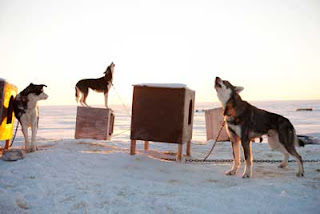
In the far north of Alaska, the fragile food web that supports polar bears and humans alike may be starting to unravel
On a Saturday morning in late November in Kotzebue, Alaska, a village 33 miles north of the Arctic Circle, two Inupiat men nursed cups of coffee at the Bayside Inn. They stared out a window at Kotzebue Sound, an arm of the Chukchi Sea at the southern edge of the Arctic Ocean. Outside it was 35 degrees and raining. "Too warm," said one of the men.
His companion let a long silence pass. Then he nodded. "Too much rain," he said. Indeed. In Kotzebue, November temperatures normally hover in the single digits. But these aren’t normal times. This is the time of "the changes" -- a term used by Caleb Pungowiyi, former president of the Inuit Circumpolar Council and one of Kotzebue’s most respected elders, when talking about the effects of climate change in the Alaskan Arctic. "Some events like this happen occasionally," Pungowiyi told me as we sat looking out at the rain. "But for something to happen that’s this warm, in November, for a number of days -- these kinds of temperatures are not normal. We should be down in the teens and minus temperatures this time of year."
A few days of rainy weather isn’t climate, but it is a powerful data point. You get enough warm, rainy days like this, and pretty soon they add up. This is how climate change happens in the far north: one warm rainy day at a time.
The thawing of the far north is one of the signal ecological events of our time. Global temperatures rose an average of 1.18 degrees Fahrenheit from 1905 to 2005, but that increase wasn’t evenly distributed. The Arctic took the brunt of it, warming nearly twice as fast as the rest of the planet. Since 1980, winter sea ice in the Arctic has lost almost half its thickness. In Kotzebue, the mean winter temperature has climbed more than 6 degrees in the past 50 years. Permafrost is thawing in patches all over the Arctic. "What we’re doing with climate change," says Brendan Kelly, a former University of Alaska biologist who is now deputy director of the National Science Foundation’s Arctic Sciences Division, "is carrying out a long-term scientific experiment at continental scale."
To get a sense of how that experiment is unfolding, it’s helpful to take a look at one of the most fundamental acts of life: eating, the passage of energy from one living organism to another. Predators and prey form a food chain, plant to insect to rodent to carnivore to apex predator. Those chains interlock to form webs. "To protect Nature," the conservation biologist Stuart Pimm wrote in his seminal book Food Webs, "we must have some understanding of her complexities, for which the food web is the basic description."...

Continue reading
Bruce Barcott @'onearth'

World’s cities are the ‘battleground’ in fight against climate change

The world's cities are going to have to move aggressively to curb their greenhouse-gas emissions, or the whole planet is going to pay for it.
That's the word in a new report from the United Nations Human Settlement Program, or UN-HABITAT. The report is called "Hot Cities: Battle-Ground for Climate Change," (you can find a summary and links to purchase the full report here). It paints a dire picture of how an increasingly urban and wealthy global population could mean "potentially devastating effects of climate change on urban populations":
Urban centres have become the real battle-ground in the fight against climate change and cities will neglect their role in responding to this crisis at their peril. Not just their own peril but that of the world. This is the tough and urgent message of UN-HABITAT's new "Cities and Climate Change: Global Report on Human settlements 2011."
According to the report, the world's cities are responsible for up to 70 per cent of harmful greenhouse gases while occupying just 2 per cent of its land. What goes on in cities, and how they manage their impact on the environment, lies at the core of the problem. It is the combination of urbanization's fast pace and the demand for development that poses the major threat.
"Cities are responsible for the majority of our harmful greenhouse gases. But they are also places where the greatest efficiencies can be made. This makes it imperative that we understand the form and content of urbanization so that we can reduce our footprint," said Joan Clos Executive Director of UN-HABITAT. "Understanding the contribution of cities to climate change will help us intervene at the local level. With better urban planning and greater citizen participation we can make our hot cities cool again."...

Continue reading
Sarah Goodyear @'grist'
Global Clean Energy Investment Reached Record $243 Billion in 2010
Global clean energy finance and investment grew significantly in 2010 to $243 billion, a 30 percent increase from the previous year. China, Germany, Italy and India were among the nations that most successfully attracted private investments, according to new research released by The Pew Charitable Trusts.
China continued to solidify its position as the world's clean energy powerhouse. Its record $54.4 billion in investments in 2010 represents a 39 percent increase from 2009. Germany was second in the G-20, up from third last year, after experiencing a 100 percent increase in investment to $41.2 billion.
"The clean energy sector is emerging as one of the most dynamic and competitive in the world, witnessing 630 percent growth in finance and investments since 2004," said Phyllis Cuttino, director of Pew's Clean Energy Program. "Countries like China, Germany and India were attractive to financers because they have national policies that support renewable energy standards, carbon reduction targets and/or incentives for investment and production that create long-term certainty for investors."
The United States, which had maintained the top spot until 2008, fell another rung in 2010 to third with $34 billion. The United Kingdom experienced the largest decline among the G-20, falling from fifth to 13th. The report suggests that uncertainty surrounding clean energy policies in these countries is causing investors to look elsewhere for opportunities.
Italy attracted $13.9 billion in clean energy financing last year, improving its global standing to fourth, from eight in 2009. Italy is the first country to achieve grid parity, or cost-competitiveness, for solar energy. For the first time, India joined the top 10 ranking, attracting $4 billion, a 25 percent increase.
Wind power continued to be the favored technology for investors at $95 billion. However, the solar sector experienced significant growth in 2010, with investments growing 53 percent to a record $79 billion and more than 17 gigawatts of new generating capacity globally. Germany accounted for 45 percent of global solar investments.
"Looking at global trends, the solar sector experienced the strongest growth among the various technologies, led by small-scale residential projects," said Michael Liebreich, CEO of Bloomberg New Energy Finance. "Declining prices and important government support helped the solar sector achieve 40 percent of total clean energy investment in 2010."
Other key findings from the report include:
China continued to solidify its position as the world's clean energy powerhouse. Its record $54.4 billion in investments in 2010 represents a 39 percent increase from 2009. Germany was second in the G-20, up from third last year, after experiencing a 100 percent increase in investment to $41.2 billion.
"The clean energy sector is emerging as one of the most dynamic and competitive in the world, witnessing 630 percent growth in finance and investments since 2004," said Phyllis Cuttino, director of Pew's Clean Energy Program. "Countries like China, Germany and India were attractive to financers because they have national policies that support renewable energy standards, carbon reduction targets and/or incentives for investment and production that create long-term certainty for investors."
The United States, which had maintained the top spot until 2008, fell another rung in 2010 to third with $34 billion. The United Kingdom experienced the largest decline among the G-20, falling from fifth to 13th. The report suggests that uncertainty surrounding clean energy policies in these countries is causing investors to look elsewhere for opportunities.
Italy attracted $13.9 billion in clean energy financing last year, improving its global standing to fourth, from eight in 2009. Italy is the first country to achieve grid parity, or cost-competitiveness, for solar energy. For the first time, India joined the top 10 ranking, attracting $4 billion, a 25 percent increase.
Wind power continued to be the favored technology for investors at $95 billion. However, the solar sector experienced significant growth in 2010, with investments growing 53 percent to a record $79 billion and more than 17 gigawatts of new generating capacity globally. Germany accounted for 45 percent of global solar investments.
"Looking at global trends, the solar sector experienced the strongest growth among the various technologies, led by small-scale residential projects," said Michael Liebreich, CEO of Bloomberg New Energy Finance. "Declining prices and important government support helped the solar sector achieve 40 percent of total clean energy investment in 2010."
Other key findings from the report include:
- Regionally, Europe remained the leading recipient, attracting $94.4 billion, led by Germany ($41.2 billion) and Italy ($13.9 billion).
- The Asia/Oceania region, led by China, continued its sharp rise, attracting $8.2 billion, a 33 percent increase over the previous year.
- The Americas also saw investment grow 35 percent, but as a region it remains a distant third, attracting $65.8 billion.
- Investments in small-scale, residential solar grew by 100 percent to $56.4 billion in the G-20. Germany accounts for nearly half the total, followed by Japan, France, Italy and the United States.
- Installed generating capacity increased to 388 gigawatts from wind, small-hydro, biomass, solar, geothermal and marine, with China accounting for more than 25 percent of the global total.
- Excluding research and development funding ($35 billion), investment totaled $198 billion.
- Increasing 15 percent to $118 billion, asset financing accounted for the majority of private investment in G-20 countries.
- Public market financing grew 27 percent to $15.9 billion, as companies launched public stock offerings to raise capital for expansion.
- Venture capital/private equity investments in clean energy increased 26 percent to $8.1 billion. The U.S. led with $6 billion, three-quarters of the G-20 total.
- Click here to read the China press release; Click here to read the China press release translated into Chinese
- Click here to read the Germany press release; Click here to read the Germany press release translated into German
- Click here to read the India press release
- Click here to read the Italy press release; Click here to read the Italy press release translated into Italian
- Click here to read the UK press release
- Click here to read the U.S. press release
Read the entire report, including country profiles, interactive graphics and video at www.PewEnvironment.org/CleanEnergy.
Releases (PDFs):


Interview with Anti-Mountaintop Removal Movement Leader Bo Webb on Next Steps
 Bo Webb, photo courtesy of Appalachia Rising
“Next Steps for the Anti-Mountaintop Removal Movement” will be a series of interviews with affected residents and activists in the central Appalachian coalfields region, including West Virginia leader Bo Webb, Kentuckian Teri Blanton, Kathy Selvage in Virginia, Ash-Lee Woodard Henderson in Tennessee, and Appalachian Voices legislative aide JW Randolph in Washington, D.C. While the EPA scrambles to enforce the Clean Water Act and a Republican-controlled Congress attempts to defund strip-mining regulatory measures, and various state agencies continue to be embroiled in Big Coal machinations, millions of pounds of devastating explosives are detonated daily across mountain communities in central Appalachia. As a national movement, what should anti-mountaintop removal activists do next?
Living underneath a mountaintop removal mining operation in the Coal River Valley in West Virginia, Bo Webb has emerged as one of the most important frontline voices in the coalfield justice movement. Winner of the Purpose Prize last year, this coal miner’s son has met with and lobbied EPA and OSMRE officials and members of Congress, made personal appeals to President Obama, co-founded the Mountain Justice movement with Judy Bonds and many others, worked with the Coal River Mountain Watch organization, and organized and led numerous protests, marches and health care campaigns in West Virginia and Washington, D.C.
JB: Thanks to years of advocacy and actions by a growing movement, the EPA issued strict guidance rules on mountaintop removal operations last year, which EPA administrator Lisa Jackson acknowledged would end most valley fill operations. Do you think the EPA gone as far as it possibly (and politically) can in “regulating” mountaintop removal or should the EPA still be the focused of lobbying pressure?
BW: Absolutely not. The EPA can simply enforce the Clean Water Act and end mountaintop removal (MTR) now. They have not addressed, tested, or studied the air quality issue of people beneath these MTR sites being forced to breathe toxic blasting fallout of diesel fuel, ammonium nitrate, silica from blasted sandstone rock nor fungal bacteria that may be uncovered with blasting. In the interest of public health the EPA should immediately place a moratorium on all MTR operations until they can conduct a health study of the long-term effects of MTR on the people in communities beneath these sacrifice zones.
JB: Do you think mountaintop removal mining needs to be framed as only an environmental issue — and thus, attracting more support from mainstream environmental organizations in D.C. and beyond — or as a human rights and health care issue?
BW: It has all too often been framed as an environmental issue and in a sense it is, but far greater than it being an environmental issue it is a human rights issue. I spent my day yesterday in the once town of Lindytown and Twilight, WV. Any reasonable thinking person that should visit this place would conclude that they have witnessed the resulting act of ethnic cleansing...

JB: Thanks to years of advocacy and actions by a growing movement, the EPA issued strict guidance rules on mountaintop removal operations last year, which EPA administrator Lisa Jackson acknowledged would end most valley fill operations. Do you think the EPA gone as far as it possibly (and politically) can in “regulating” mountaintop removal or should the EPA still be the focused of lobbying pressure?
BW: Absolutely not. The EPA can simply enforce the Clean Water Act and end mountaintop removal (MTR) now. They have not addressed, tested, or studied the air quality issue of people beneath these MTR sites being forced to breathe toxic blasting fallout of diesel fuel, ammonium nitrate, silica from blasted sandstone rock nor fungal bacteria that may be uncovered with blasting. In the interest of public health the EPA should immediately place a moratorium on all MTR operations until they can conduct a health study of the long-term effects of MTR on the people in communities beneath these sacrifice zones.
JB: Do you think mountaintop removal mining needs to be framed as only an environmental issue — and thus, attracting more support from mainstream environmental organizations in D.C. and beyond — or as a human rights and health care issue?
BW: It has all too often been framed as an environmental issue and in a sense it is, but far greater than it being an environmental issue it is a human rights issue. I spent my day yesterday in the once town of Lindytown and Twilight, WV. Any reasonable thinking person that should visit this place would conclude that they have witnessed the resulting act of ethnic cleansing...
Continue reading
Jeff Biggers @'AlterNet'



Subscribe to:
Posts (Atom)