
Following on from 'Pride & Prejudice and Zombies' comes the new classic. Available September 15th.
Details here.
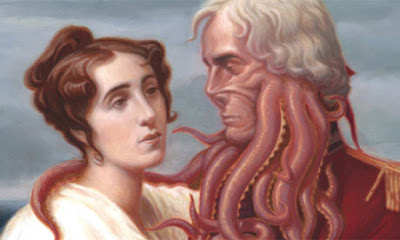 For A - who just doesn't get it..."Why?"
Details here.
 For A - who just doesn't get it..."Why?"For A - who just doesn't get it..."Why?"
 Hashemi Rafsanjani at Friday prayers under the pictures of Ayatollah Khomeini, left, and supreme leader Ayatollah Ali Khamenei. Photograph: Meisam Hosseini/AP

We excel in creating arbitrary lines on maps; delineating countless villages, towns, cities, counties, states, and nations from one another. These arbitrary lines exert influences on our lives subtle or great. For many they are the difference between life and death.
An unseen ruler
Defines with geometry
An unrulable
Expanse of geography
An aerial photographer
Over-exposed
To the cartologist's 2D
Images knows
The areas where the water flowed
So petrified the landscape grows
Children die everyday in America, the richest nation on earth, for lack of healthcare. Some of these kids live just a few dozens of miles from Canada - a place with national healthcare. The difference is even greater comparing Mexico to the United States. San Diego is just twenty miles from Tijuana, but the arbitrary line that divides the lives of their respective citizens is of unimaginable consequence. Even within nations arbitrary lines determine our lives - from the schools we attend to the doctors we see to the politicians that represent us.
Straining eyes try to understand
The works
Incessantly in hand
The carving and the paring of the land
The quarter-square the graph divides
Beneath the rule a country hides
Wire, a British art-punk band from the 1970's, wrote a song that doesn't directly address this issue, but that I've always associated with it, Map Ref. 41°N 93°W, from their album 154 released in 1979.
Chorus, interrupting my train of thought
Lines
Of longitude and latitude
Define, refine
My altitude
Perhaps the reason is because poetry is not dead, but is visible most prominently today in song lyrics. And, as postulated by Walter Pater, the poet creates a sense of an idea and doesn't have to spell it out exactly. Ambiguity, metaphor, interpretation: I choose to interpret this as a song about arbitrary lines on the map.
The curtain's undrawn
Harness fitted, no escape
Common and peaceful, duck, flat, lowland
Landscape, canal, canard, water-coloured
Crystal palaces
For floral kings
A well-known waving
Span of wings
Witness, the sinking of the sun
A deep breath of submission has begun
Of course I’ll never understand why the song’s title has map coordinates that point suspiciously close to Des Moines, Iowa.
Interrupting my train of thought
Lines
Of longitude and latitude
Define, refine
My altitude
Songwriting credits go to Colin Newman, Bruce Gilbert, and Graham Lewis of Wire. As always, lyrics are as I hear them after repeated listenings.
 The other day the Spacebubs accompanied me on an outing around his local op-shops...and well instead of looking around the CD's and books like I usually do, we just ended up dancing in front of the radio instead.

 “Although believed to have been painted at the start of the year, images of Banksy’s street pieces in Africa are only now beginning to circulate. These great pieces are thought to be in Mali.”
 Tai Djin was born in Fukien, China in 1849. His parents, not knowing what caused their baby’s hairiness, abandoned him in a forest. Tai was found by a monk who took him to the Shaolin Temple where he was cared for by the Shaolin Masters. Tai grew up to be highly educated, knowing he wouldn’t have much of a life outside the temple. He threw himself into learning martial arts -not just one discipline, but all of them! Tai achieved the title of Grand Master and is known from that point on as Su Kong Tai Djin. He was revered by his many students until (and even after) his death in 1928.
 @ Urban Prankster

 Photo of the attack on Karroubi earlier today causing his turban to come off!
PARIS (Reuters) - Iran has arrested at least seven photographers since its disputed presidential election, with the most recent arrests occurring less than a week ago, media watchdog Reporters Without Borders said on Friday.
Images of blood-smeared protesters have captured the drama of the unrest provoked by last month's election result and footage of the death of a young Iranian woman, Neda Agha-Soltan, has become an icon of opposition protests.
"The Tehran regime is scared of images. The authorities have launched a real hunt on visual reporters so that no professional photo or video of sensitive subjects will leave the country," the Paris-based organization said in a statement.
Iran crushed the protests and in early July said most of the people arrested during the events had since been released.
Reporters Without Borders, an organization campaigning for press freedom, said five photographers were arrested less than a week ago.
It said the photographer Mehdi Zabouli was arrested on June 20, and his Franco-Iranian colleague Said Movahedi, on July 9.
Photographers Tohid Bighi, Majid Saidi, Satyar Emami, Marjan Abdolahian and Koroush Javan were arrested on July 11, it said, and at least five others have been injured by police or militias.
Four days after the election, Iran banned foreign media journalists from filming or taking photos of the protests, or even leaving their offices to cover the events.
(Reporting by Sophie Hardach; Editing by Angus MacSwan)@Reuters

Incredible scenes this morning at Friday prayers in Tehran. Former President Hashemi Rafsanjani used strong language in his sermon, saying debate over the election should be re-opened. Opposition leader Mirhossein Mousavi was sitting in the front row, his first public appearance in weeks.
Eyewitnesses tells ABC News thousands of Moussavi supporters are rallying near Tehran University and that police are responding with violence. One eyewitness told me she and her mother were beaten, and not just by the paramilitary basiji but also by regular police who had been less aggressive in recent demonstrations.
This is significant. Iranians had been on pins and needles to see what Rafsanjani would say. Some right-wing newspapers indicated – and some opposition supporters worried – that Rafsanjani would capitulate but he didn’t. This is the clearest sign recently that the conflict is far from over inside the Iranian leadership. Other hard-liners, such as former candidate Mohsen Rezaei, have also refused to pronounce the dispute over. (Rezaei is known as an opportunist who likes to bend with the political winds so the fact that he’s hedging his bets is another sign the opposition isn’t a spent force.) And to see thousands of supporters in the streets – even bigger than the crowds on July 9 anniversary of the 1999 student uprising – shows the street protests are far from over either.


A photo the Associated Press received from an individual in Tehran, showing a man said to have been injured during today's clashes. AP photo
By Mark Memmott
"Clashes erupted ... in central Tehran" today, Reuters reports.
The wire service says there was violence involving "police and followers of opposition leader Mir Hossein Mousavi."
It quotes one witness as saying "police fired tear gas and beat supporters of Mousavi in Keshavarz Boulevard."
The Associated Press says that "pro-government Basiji militiamen in front of a line of riot police fired tear gas at hundreds of opposition protesters who changed 'death to the dictator' and called on President Mahmoud Ahmadinejad to resign."
This followed a sermon today by former Iranian president Akbar Hashemi Rafsanjani, who called for the release of those who have been arrested during previous protests over the disputed June 12 presidential election, which Mousavi and his supporters believe was rigged in favor of Ahmadinejad.
At the Los Angeles Times' Babylon & Beyond blog, there's video that's said to show "crowds of angry opposition supporters" reacting to Rafsanjani's sermon.
The Guardian is reporting that:
Outside Tehran University police fired teargas at Mousavi supporters who were demanding the release of detainees in the biggest anti-government protest since the mass demonstrations that immediately followed the contested election. At least 15 people were arrested, witnesses said.
Tehran Bureau has a photo it says shows Mousavi at the Friday prayers service where Rafsanjani spoke.


I met William Burroughs in 1971. I got his address through a magazine and went to London to spend time with him. Right away I asked about Brion Gysin. Gysin would always be in the dedications or introductions to Burroughs's books, but he was a mysterious character, who got little attention from the public and the people I knew. I wondered who he was and about his past in terms of the bigger picture of Burroughs's experiments, particularly with tape recorders and cut-ups.
Burroughs wrote me a letter of introduction and I contacted Gysin in Paris. When I met him, I felt I knew why he was kept hidden away. He was an amazingly charming man with a powerful energy and kaleidoscopic knowledge. Once you had met him, everyone else seemed a little dull.
To me, Gysin was the source of the energy we associate with the most radical experiments of the Beats. He was the real source of the ideas; other people just applied them. That was a really important shift in my appreciation of the Beatnik phenomenon. From that moment I was hooked, fascinated and impressed by each layer of Gysin I discovered. As I peeled things away over the years, I was never disappointed. There was never an end to it. He was the only person I've met whom I would unquestioningly call a genius.
My first clear idea of him as an important contemporary artist and writer was through The Third Mind. Even now, I would recommend that as a very powerful manual on contemporary culture and how to explore it. I think it's the bible of experimentalism of the past 50 years.
Gysin trivialised his application of cut-ups, saying that he accidentally cut through newspapers, assembled the pieces and was amused by what he read across the page. But it was obvious he had lived in Paris through the key moments of the art movements of the 20th century, particularly Dada and surrealism, and that he was very aware of the Tristan Tzara tradition of throwing words into a hat, pulling them out and reading a poem.
Gysin was more methodical than he pretended. He understood more than anyone else at that point in culture that, just as we can take apart particles until there's a mystery, so we can do the same with culture, with words, language and image. Everything can be sliced and diced and reassembled, with no limit to the possible combinations.
I spent six years trying to persuade Burroughs to release an album of the tape-recorder experiments he and Gysin had made. The implications of the cut-ups, the technology and tape experiments and the Dreamachine are powerful and far reaching. There's an amazing piece of tape from the 1950s, featuring Gregory Corso, Burroughs, Gysin and a couple other Beats, on which you can actually hear William cutting up a letter and saying: "Let's see what it really says."
These mythological moments affected not just the careers of the protagonists, but our whole attitude to sampling, tape loops and new ways of organising popular music that would not have happened otherwise. These tape-recorder experiments in Paris are absolutely the root of industrial music. There's a very specific lineage of experimentation.
I would place Gysin at the junction of the old way of perceiving the world and the new - a kind of Leonardo da Vinci of the last century. It's no accident that the atom got split and gave us particle physics at the time LSD was doing the same with consciousness and Gysin and Burroughs were doing it with culture.
Though Gysin was outwardly rather sceptical, in private he was very mystical and interested in the tradition of the artist-healer. If one didn't look at the very nature of how we build and describe our world, he thought, we get into very dangerous places. Once you believe things are permanent, you're trapped in a world without doors. Gysin constructed a room with infinite doors for us to walk through.
What amazed me about Gysin's work was how it could be applied to behaviour: there were techniques to free oneself through the equivalent of cutting up and reassembling words. If we confound and break up the proposed unfolding the world impresses upon us, we can give ourselves the space to consider what we want to be as a species.
I first saw Gysin's calligraphic works as abstract paintings. Gysin told me they were paintings of light and, once I saw they were depictions of light striking things, I began to see people, trees, landscapes, all kinds of vistas that were realities I hadn't seen before. He basically paints portals that shift our perception as we look, changing the way we see things.
The Dreamachine was the first artwork to be looked at with the eyes closed. Gysin's art illustrates the way the eye and the brain decode information. If you work with a dreamachine you go through various stages that relate to Gysin's paintings and drawings, which actually documented the images that seem to occur when you are fed pure light by flicker.
More interesting is that a lot of them were done as magical, functional paintings. He would take words, break them down into hieroglyphics, then turn the paper and do it again and again until the magical square was filled with words. Gysin worked with the idea of painting as magic, to change the perception of people and to reprogramme the human nervous system.
The original motives for what we now call art were the functional techniques of the shaman to make things happen (for a hunt to be successful, for example), to explore dimensions of consciousness that would otherwise be inaccessible, much like the Dreamachine. Gysin used any medium, working with it to find a way to demonstrate that reality could be turned into a jigsaw: then we could make the pictures we wanted from it rather than inheriting them from other people.
His last painting, Caligraffiti of Fire, was a beautiful work hung on all four walls of a room so that you had to spin round to see it. Instead of the Dreamachine spinning and the viewer being static with their eyes closed, the viewer stands in the centre of the room and spins with eyes open. People are tricked by it into doing a dervish dance. I'd imagine, in the perfect situation, Gysin would have liked the viewer to spin round until they fell over, and then see what happened.
I made an agreement with Gysin before his death that I would try to champion and vindicate his work and legacy. He was living opposite the Beaubourg in Paris, and any time I had spare money I would go to see him. I'd get up and go to his apartment at around 11am, make mint tea, then sit down at his table by the new flower arrangement - he liked to have fresh flowers - and start talking. And then it would be 11 at night and I'd go back to where I was staying and come back the next morning. In a way, he was my university. I'm glad to have been a student.
· Genesis P Orridge was talking to Tim Cumming.
From 'The Guardian' 15 November 2003.
However there is also this.


 Bonus:Audio
 VINYL FORMAT. INSOUND EXCLUSIVE! The limited deluxe vinyl version of Destiny Street Repaired includes the ten repaired tracks from the original Destiny Street album, a folded 18" x 24" color poster featuring a Roberta Bayley photo on one side, and art by Josh Smith that incorporates Richard's liner notes on the other. The cover art for "Destiny Street Repaired" is a modification by renowned Scottish artist, Jim Lambie, of the original album art. The deluxe vinyl version also comes with a CD that includes the ten repaired tracks plus two additional bonus tracks that were recorded as studio demos in 1979: "Smitten" (never before released anywhere) and "Funhunt" (previously released only in a live version on an out-of-print ROIR cassette). In addition, every limited deluxe vinyl copy will be numbered (one to one-thousand) and signed by Richard Hell.
 Top photo of Bachir Attar, G-P'O & Timothy Wylie
 A well-known Russian rights activist was found slain execution-style on Wednesday, hours after being kidnapped in Chechnya – the latest in a series of brazen murders targeting critics of the Kremlin's violent policies in the war-torn North Caucasus.





Hi Stewart,
Great review of the Book. I met Timothy Wyllie in 1989 while I was a musical member of Psychic TV. He seemed like a nice guy still coming to terms with having left a genuine cult. We spoke about George Clinton and the dominatrix mentality.
Gen’s TOPY essay inclusion is naturally mythologically self serving and exposes Gen for the incompetent cult leader he wishes he could be. As far as I recall nobody had to turn over all their money and belongings to join TOPY. Since myself and the majority of the members of the band had nothing really to do with TOPY except tolerating their inane chatter and trying to help them think for themselves they did come in handy when baby sitters were needed.
Now that Gen has chosen his pandrogyny surgical self this only seems to show that the only parrallel between The Process and TOPY is that Gen is a wannabee Mary Anne MacLean with hideous plastic surgery, who wishes he could have had the financial power over his followers that afforded the kind of lifestyle Mary Anne and Robert enjoyed. An address in Hackney is a lot different than Mayfair.
telepathic regards,
fred.giannelli
Hey Fred, you sum it up nicely. I was very aware of TOPY members being used as babysitters in London and Brighton. The sleight-of-hand Old Lumpy used was hilarious. Gen addressing TOPY member: “Will you do something for Thee Temple”. TOPY member: “Yes”. Gen: “Right, you’re babysitting the kids tonight, be round at 7pm sharp, Me and Paula are going out.”
Then there was Old Lumpy’s “I’ve copyrighted the psychic cross and I’ll get my lawyers onto you if you persist in using it…” routine. This one didn’t work so well, because an older hand would let those threatened – like the US TOPY activists after Old Lumpy got pissed off with them for not following orders – know that Genesis was talking bollocks as usual and that there was no copyright on the psychic cross. Old Lumpy not only couldn’t control his fan club cum cult, he ended up destroying it and any belief the members once had in his bullshit. Oh well, at least he’s a source of amusing anecdotes. And actually I know a number of ex-TOPY people who are really great guys.
While obviously very confused, Timothy Wyllie comes across in the book like the nice guy you say you found him to be. But I’d have liked a chapter dedicated to George Clinton, now there’s not just a fab musician but also a showman!
“Old Lumpy” !!! That is hilarious. Nobody likes to have LUMPS in their P-Orridge !