Monday, 19 September 2011

Pressure on attorney general to block Met move against press freedom

The attorney general, Dominic Grieve, is facing growing pressure to block an attempt by the Metropolitan police to use the Official Secrets Act to force journalists to reveal their sources.
As senior Liberal Democrats indicated that Nick Clegg was "sympathetic" to journalists, police sources also expressed unease after Scotland Yard applied last week for an order under the 1989 act to require the Guardian to identify its sources on phone hacking. One police source said the decision to invoke the act was "likely to end in tears" for the Met.
Lib Dem sources said that as deputy prime minister, Clegg was unable to express a view on what action the attorney general should take. But senior Lib Dems lined up at the party conference in Birmingham to call on the attorney general to use his powers to rule that the Yard's use of the act is not in the public interest.
Simon Hughes, the Lib Dem deputy leader, who is suing News International over alleged phone hacking at the News of the World, said: "Millions of people believe the Guardian has done a public service by exposing the series of scandals behind phone hacking carried out on a regular basis by individuals on behalf of other media organisations like the Murdoch empire. It is entirely inappropriate for the Officials Secret Act to be used to try to prosecute journalists who have taken these actions.
"I hope that the law officers, or the government more widely, will make it clear that such an intervention and such a prosecution would not be in the public interest. The police or the Crown Prosecution Service may be able to justify on technical grounds that this is the proper thing to do. But the wider interests should prevail and the sooner a decision is made to end plans to prosecute the better."
Don Foster, a veteran Lib Dem MP who advises the culture secretary, Jeremy Hunt, informally on media issues, called on the attorney general to block the "extremely bizarre" use of the act. "I understand the attorney general has the opportunity to use this power," Foster said after a fringe meeting, organised by the Hacked Off campaign, that was addressed by the actor Hugh Grant. "He should use it and say this is not in the public interest."
Foster, who praised the Guardian for "fantastic journalism" in exposing phone hacking, found unanimous support at the fringe meeting when he asked whether the Guardian's disclosure that Milly Dowler's phone had been hacked – the revelation that prompted the police use of the Official Secrets Act – was justified. The MP said: "If it was in the public interest for the Guardian to do what they did, it is extremely bizarre, it is almost unheard of, for the Metropolitan police to have used the Official Secrets Act as the basis for seeking to get hold of the information they want.
"It is absolutely vital that we find out first of all who actually signed off agreement to use the Official Secrets Act and, secondly, we have to have a very, very clear explanation of why they are doing it. A final decision is made by the attorney general as to whether to allow it to happen. The one good bit of news is that, in making his decision, the attorney general can use public interest as one of the criteria that he considers. I hope he will very seriously indeed."
The Met's actions were also condemned by other newspapers: in a leader in the Times, the Met is accused of using the Official Secrets Act "not to protect the public interest but as a punitive measure to curb journalistic inquiry and pursue a sectarian and self-interested campaign". It goes on to say that the "principle and the method in the Met's action are wrong. They are not only a constraint on the Guardian's reporting, but an attack on the principles of free expression, the workings of a free press and the future of investigative journalism".
The Daily Telegraph described the situation as a "direct attack on the freedom of the press" and "an intolerable abuse of power". Its leader asks if the Met are "seriously contemplating that the first prosecutions arising from the phone-hacking scandal should involve the very people who exposed it?"
Tom Brake, chair of the Lib Dem home affairs committee, said: "The use of the Official Secrets Act in these circumstances is very unusual, and all the more worrying because it does not allow the defendant to argue that their actions were in the public interest. The Met need to explain why they think it is appropriate to use the Official Secrets Act in this case. While this is clearly a matter for the police and the attorney general, I do question whether this action is in the public interest given everything that has happened, or indeed in the interests of investigative journalism."
The political unease was echoed in police circles. One insider asked: "When was the last time the OSA [Official Secrets Act] was used successfully against the media?"
The source added that the Met had to be seen to be rigorous, but threatening to get a production order requiring the handing over of notes and the revealing of sources was a step too far: "No one was expecting us to use the OSA. Usually the use of the OSA ends in tears." With the new Met commissioner, Bernard Hogan-Howe, not due to start his job as Britain's top police officer officially until later this month, the source added: "He is not even in office and he is facing his first crisis."
Grant said at the Hacked Off meeting: "A lot of us victims and campaigners had come to the view that the new police inquiry – [Operation] Weeting under Sue Akers – were good cops. It was a new investigation. They were embarrassed by the behaviour of their predecessors and colleagues. So for them to suddenly turn on their fellow goodies in this battle is worrying and deeply mysterious."
The Met said that the application for a production order was made under the Police and Criminal Evidence Act and did not seek to use powers under the OSA. But the police said that the OSA was mentioned in the application because a possible offence under that act might have been committed.
Nicholas Watt and Vikram Dodd @'The Guardian'

♪♫ The Twilight Singers w/ Mark Lanegan - Number Nine (live @Great American Music Hall, SF - Sep 17,2011)

Pirate Party Enters Berlin Parliament After Historical Election Win

For the first time in history a Pirate Party has managed to enter a state parliament. With an estimated 9 percent of the total vote the Pirate Party exceeded the 5% floor needed to enter the Berlin parliament with several seats. For the international Pirate Party movement this is the second major success after the European elections of 2009.
piratenThe German Pirate Party has scored a massive win in the elections for the Berlin state parliament today. Two hours after the voting booths closed the first results show the Pirates achieving 9 percent of the counted votes. This translates into 15 parliament seats.
Founded in September 2006, the German Pirate Party has already booked several successes in its relatively short existence. Before today, the party had over 50 members in elected offices across Germany, which is more than in all other countries combined. However, today’s election win trumps all previous ones.
Never before has a Pirate Party been elected into a state or federal parliament. And with the 5 percent floor that was required to enter, the achievement at the Berlin elections is all the more impressive.
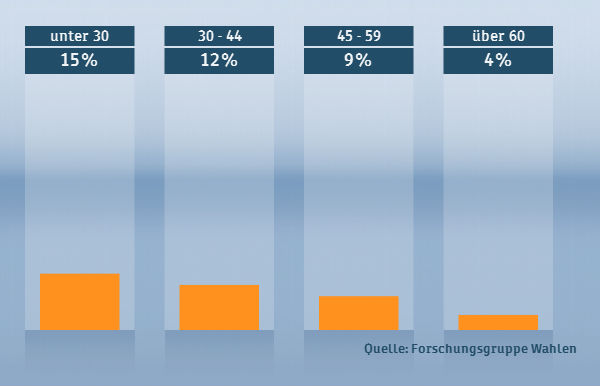
The initial results show that the Pirates received the most support from younger voters. 15 percent of people under 30 voted for the Pirate Party, but even among voters aged 60 years and up, a few percent voted for the Pirates.
Friedrichshain-Kreuzberg was the first region to finish counting, and the Pirate Party got 14.7 percent of all votes there. With 99.9 percent of the total vote counted in the state the Pirates are at 8.9 percent.
piraten
8.9% with 99.9% of the votes counted
TorrentFreak asked Sebastian Nerz, Chairman of the German Pirate Party, what this success means for the party. He told us that due to an increase in funds and influence the Pirate Party will have a greater chance to make its mark.
“At the moment the Pirate Party of Germany does not have any paid employees,” Nerz says. “Everyone working for the party – including myself – is working in an honorary capacity. In contrast, Members of Parliament are paid for their work. In addition they receive state money to pay for assistents and co-workers. This will enable those Pirates to work full-time for the party, thus giving us much more work force.”
“Another very important benefit is, that citizens and media are taking parties with access to the parliament much more seriously. A number of times i’ve heard, “Your party is not relevant because it does not have members of parliament.” Following this weekend’s successes, in this respect the party’s position will be greatly improved.
In addition the Pirate Party expects that their heightened profile will lead to an increase in members and more people working for the party. As for the party’s ideals, they want to be as transparent as possible, secure the privacy of citizens, abolish patents and limit the ever growing control of copyright exploiting organizations.
“We are going to demonstrate that it is possible to conduct a transparent approach to politics. Traditionally politics are a secret ‘no trespassing’ area. Meetings are held behind closed doors, agendas and protocols are closed, treaties are not being published,” Nerz told TorrentFreak.
“We will demonstrate that it is possible to openly and truthfully inform the citizens what is going on, what alternatives are possible and why a certain path has been chosen. We will demonstrate that citizens can be integrated into the fact-finding and path-choosing methods. Why not ask citizens about their opinion before you decide? Its well worth a try!”
One thing’s for certain. The German Pirate Party scored a sensational win today. As a result, the Berlin state parliament will undoubtedly notice the fresh wind coming from the most technology-friendly and privacy preserving party out there. All the Berlin candidates are ready and eager to start according to the chairman.
“In short: We are going to demonstrate that politics can be reformed,” Nerz says.
Note: we will update the percentages and other information as more information comes in. (updated 00:20 CET)
The election win is currently being celebrated by hundreds of Pirate Party enthusiasts in Berlin, including the founder of the Swedish and first Pirate Party Rick Falkvinge. Rick already predicted the massive win yesterday and shared a picture of the festivities with TorrentFreak.

Party like it’s no longer 1984
null
“Pirates of Berlin, thank you for your fantastic work in making tonight happen. We all stand shoulder to shoulder in fighting for the next generation — one of succeeding is all of us succeeding. Tomorrow, people will look to your success, and the movement will grow yet more. You are the source of inspiration for the next wave of civil liberties activists,” Falkvinge adds in a blog post.
Ernesto @'Torrent Freak'

What does it feel like to fly over planet Earth?

A time-lapse taken from the front of the International Space Station as it orbits our planet at night. This movie begins over the Pacific Ocean and continues over North and South America before entering daylight near Antarctica. Visible cities, countries and landmarks include (in order) Vancouver Island, Victoria, Vancouver, Seattle, Portland, San Fransisco, Los Angeles. Phoenix. Multiple cities in Texas, New Mexico and Mexico. Mexico City, the Gulf of Mexico, the Yucatan Peninsula, Lightning in the Pacific Ocean, Guatemala, Panama, Columbia, Ecuador, Peru, Chile, and the Amazon. Also visible is the earths ionosphere (thin yellow line) and the stars of our galaxy. Raw data was downloaded from;
The Gateway To Astronaut Photography of Earth
"http://eol.jsc.nasa.gov/sseop/mrf.htm ".
Virtualdub was used to create the final movie.

Sunday, 18 September 2011

Israel: Adrift at Sea Alone

♪♫ Wire - Drill (Late Show)

WTF???

(Click to enlarge)
Via

Cut Copy - Blink And You'll Miss A Revolution

Met use Official Secrets Act to demand Guardian reveals sources

Met's threats to Guardian are 'direct attack on free press', say lawyers

Psycho

Wall St.
Via

The Opiates - Anatomy of a Plastic Girl (Chris & Cosey Remix)

Tingling Neurons Titillate your Tinnitus

How Long Can You Stand 2 KHz and 4 KHz?
John Perry Barlow
There are reports that the NYPD are trying to keep media from parking feed trucks near

Cocksucker Blues

Via

Heroes & Heroins

Debbie Harry & Richard Hell

Wall Street

Via


Saturday, 17 September 2011

James Blake Essential Mix for Radio 1 17th September, 2011

Tracklist:
Erik Satie – Gnossienne No.5
James Blake – Olivia Kept
James Blake Versus Drake – Half Heat Full Versus Up All Night
James Blake – Pan
SALEM – Trapdoor
Snoop Dogg – Drop it like it’s Not (Harmonimix)
[unknown] – Unknown
Klaus – Tarry
D’Angelo – One mo’ Gin
[unknown] – Sicko Cell
Blawan – What You Do With What You Have [R&S Records]
James Blake – No More Than A Road (Dub)
James Blake – At Birth (Dub)
The Chain – Suffer For Your Art [R&S Records]
Peverelist – Roll With The Punches (Harmonimix)
[unknown] – Navigator
OutKast – Return of the G
Africa Hitech – Out In The Street
DJ Nate – 3 Peat
James Blake – Deeds
Gavin Bryars – Three Elegies for Nine Clarinets II
Gavin Bryars – Three Elegies for Nine Clarinets III
Odi et Amo – Johann Johannsson
Grouper – Vessel
James Blake – Untitled
[unknown] – What Was It
The Tallest Man on Earth – Love Is All
SALEM – Redlights
Rev. James Cleveland – Jesus Saves
Trim – Confidence Boost (Harmonimix)
James Blake – Evening Fell Hard For Us
James Blake – Placing Us
James Blake – Words We Both Know
Arthur Russell – Love Comes Back
(via)


"After Jamie xx‘s appearance on Radio 1′s Essential Mix a few weeks ago it is obvious that the doors have now opened for a new kind of dance music DJ to have their spotlight on the legendary show. James Blake was scheduled to appear on the show way back in May but that was mysteriously postponed until this morning when his 2 hour Essential Mix finally aired.
Over the two hour Essential Mix, James drops a load of his own music, as well as tracks from Salem, Drake, Africa Hitech and Stevie Wonder. There’s everything from classical music through to hip-hop, dubstep to soul, in what must be one of the most eclectic selections in months."
(Details of my Life so far...)

Paul Carr: I’m Leaving TechCrunch. Here’s Why

Occupy Wall St (Sept 17)

'Shaun Ryder in the Happy Mondays wasn't me. He was a caricature'

The Cyborg in Us All

The $2 Billion UBS Incident: 'Rogue Trader' My Ass

Friday, 16 September 2011

Art Pepper: Notes From A Jazz Survivor

An intensely personal and sometimes painful look into the fascinating world of Art Pepper. One of Jazz' greatest alto saxophonists and most expressive soloists, Pepper was also a thief, drug addict, alcoholic, womanizer, and world renown wildman. In candid interviews he recounts his triumphs, troubles, and luck in meeting Laurie, his last wife.
For half the film Pepper leads a trio in a Malibu nightclub, the set includes: "Red Car", "Patricia", and "Miss Who?".
Via

♪♫ Amy LaVere - Damn Love Song

Why Won't Israel Use the Upcoming UN Vote to Its Advantage?

Israel okays PA's acquisition of anti-riot gear ahead of UN vote

Israel has given approval for the Palestinian Authority to equip its security forces with riot-control gear, such as tear gas grenades and rubber bullets.
The PA has approached Israeli firms to buy such equipment in advance of expected demonstrations on the West Bank around the Palestinians' request for United Nations recognition as an independent state.
Palestinian security officials told their Israeli counterparts in their regular meetings that they will do everything within their ability to contain demonstrations and prevent violent interactions with the Israel Defense Forces and settlers. But the two sides are also preparing for the possibility that demonstrations will escalate into violence the PA will find it difficult to control. Thus, the IDF recommended a few months ago to allow the PA to acquire such equipment, so the Palestinians could deal with demonstrations before the IDF had to.
The ministers involved gave their approval at the beginning of September.
Now, the PA is working furiously to buy the equipment, but seems to be having difficulty procuring the goods because time is so short. The IDF will finish its preparations this week for a possible escalation in the territories. The Central Command will receive reinforcements of a couple of regular infantry battalions tomorrow, as part of its preliminary preparations against violent demonstrations, in the IDF's overall plan named "Summer Seeds."
At this stage, an additional 20 percent of forces are being added on the West Bank. The battalions have trained to deal with possible scenarios, including violent marches toward settlements, IDF checkpoints and major roads serving the Israeli population.
In case of an overall escalation, the IDF has prepared to double its forces in the West Bank. This plan includes bringing in regular forces now in training plus calling up a few reserve battalions on short notice. The IDF plans to minimize the damage to its training schedule, but if necessary, battalions from various advanced training courses will be called in.
The IDF has made large purchases of equipment for dispersing demonstrations, in addition to the regular equipment used in such circumstances. For example, it has brought out equipment that disperses a horrible smell or makes noise at an intolerable frequency.
The most reasonable scenario the IDF expects in the short term is for violent demonstrations in several areas, despite the PA's intentions to prevent such violence. IDF forces are preparing to defend the settlements, and should demonstrators attempt to penetrate the settlements, the army is ready to use controlled sniper fire to prevent such intrusions. It is not clear that any such conflict - if it comes - will occur in September. Such violence could break out in October or near the end of the year, a sort of delayed response to political developments.
The IDF and Shin Bet security service are also worried about the recent rise in the number of attacks carried out by right-wing extremists, including on the IDF, mosques and left-wing activists. This only complicates the situation as the PA advances its move at the UN.
Amos Harel @'Haaretz'

Instead of attacking WikiLeaks, fix what it exposed

Former Defense Secretary Robert Gates was right when he suggested that the WikiLeaks revelations were “embarrassing” and “awkward.” But his assessment — and that of so many other government officials — stems from the magnitude of what he left unsaid.
These revelations are not merely embarrassing. They also contain evidence of government actions and policies that are an abuse of power and that violate international human-rights standards to which we as Americans are committed.
For instance, through the information coming from WikiLeaks documents, the public is now aware of “FRAGO 242” — an official order not to report evidence of prisoner abuse by Iraqi security forces. This policy violates the United Nations Convention Against Torture, which was ratified by Congress in 1994. The treaty explicitly requires allegations of cruel or inhuman treatment to be investigated and brought to a halt.
In recent days, WikiLeaks has released cables that show government officials helped conceal the heinous execution of family members of suspected combatants in Iraq. The site of the murders, which included the execution-style slaying of two children and three infants, was obliterated by a subsequent coalition airstrike.
Taken as a whole, the material shows a pattern of concealing abuse by both U.S. and coalition forces. The information revealed by WikiLeaks is thus a critically important tool for those who seek to uphold basic human-rights standards and the professional conduct of U.S. military forces.
These revelations also bring our system of classification into question. Although Pfc. Bradley Manning has not yet been brought to trial, President Barack Obama has publicly declared that the former U.S. Army intelligence analyst “broke the law” by allegedly sending this restricted information to WikiLeaks.
Many civilians — and a surprising number of military personnel — are unaware that this system of classification is not grounded in any law passed by Congress. In fact, the entire edifice that allows the use of classification rests solely on the basis of executive orders that have been renewed and modified by various presidents. The ability to restrict information from the public is essentially an unchecked assertion of executive power.
However, according to Obama’s policy for classification of government documents (Executive Order 13526), there are several situations under which government information must never be classified. The government cannot use classification procedures “to conceal violations of law, inefficiency, or administrative error; prevent embarrassment to a person, organization, or agency … or prevent or delay the release of information that does not require protection in the interest of the national security.”
Administration officials have not provided any evidence that these WikiLeaks revelations have harmed our national security. They have, however, acknowledged that some of the material is personally, and professionally, embarrassing.
But they continue to act as if evidence of illegal or otherwise unethical behavior simply does not exist.
If online conversations attributed to Manning are accurate, it appears that his self-described “turning point” came when his own commanding officer refused to acknowledge clear evidence of an abuse of power. According to these conversations, Manning says he was told to investigate 15 Iraqi academics who had been brought in for questioning by Iraqi security forces, for the crime of supposedly printing “anti-Iraqi literature.”
After running the printed material through a translator, Manning realized that it was actually an article titled “Where Did the Money Go?” which sought to expose corruption within Prime Minister Nouri al-Maliki’s Cabinet. Manning’s commanding officer is said to have told Manning to “shut up” and find out how he could bring in more detainees. The message was clear: He could not rely on the chain of command to address evidence of wrongdoing.
This incident would be consistent with other revelations that have since emerged from the WikiLeaks embassy cables. Several diplomatic cables express concern about al-Maliki’s politicization of his security forces, using them to abuse political opponents.
In July, the Red Cross and a group of Iraqi parliamentarians asked for an investigation into an alleged torture facility being run by one of al-Maliki’s elite units in Baghdad’s Green Zone. That same month, the Special Inspector General for Iraqi Reconstruction issued a report that noted more than $17 billion in funds that have gone missing.
The pattern of ignoring or otherwise concealing clear evidence of abuse has become so familiar that, to many, it now seems normal. But pretending that problems don’t exist won’t make them go away.
A recent report from the Council of Europe, which convenes the European Commission on Human Rights, stated that the current “deficit of transparency” among Western security and intelligence institutions leaves no choice but for the public to rely on whistle-blowers to hold governments accountable.
Instead of punishing and silencing alleged whistle-blowers like Manning for revealing uncomfortable truths, we should honor their courage to stand up for what’s right.
That’s all we should ask any American to do.
Ann Wright @'Stars & Stripes' 

What's happening to those named WikiLeaks sources?

Husker Foo

Via Meat Puppets Facebook (after show St. Pauls September 14th)
(Thanx Martin!)

Anderson Cooper Examines Troy Davis Case


Via

Should Faking a Name on Facebook Be a Felony?

Defending 'Anonymous': Lawyers For Alleged 'Hacktivists' Speak Out

Investigating the Root Of The U.K. Riots

Nearly 2,000 people have been funneled through British courts, under charges that they participated in the riots that inflamed London and other U.K. cities this August. As judges try to get to the bottom of who did what, The Guardian newspaper and London School of Economics are partnering up to find out why the riots happened in the first place. They are launching a new project that will dispatch researchers into communities where rioting took place, to investigate the root causes. The Guardian's Paul Lewis, who's leading the project, speaks with Michele Norris.
Audio/transcript
@'npr'

Do riots show that tensions of earlier decades still smoulder?

Scum, thugs, feral rats, wolves, an army of ants on their BlackBerrys … the dehumanising epithets flew like bricks through a JD Sports window last week. Then came the fightback to mend what David Cameron called "criminality, pure and simple" in our "sick" and "broken" society. The government seems to blame the recent havoc across England solely on individuals with too many rights and too few responsibilities, and appears to think that badly parented kids just woke up one morning and decided to do a bit of free shopping.
There is even talk – from the very same David Cameron who not long ago was saying the state should not intervene to change individuals' behaviour – of curfews, banning face masks, evicting criminals from council housing, tougher court powers, curbing social media, not to mention more "robust" policing and teaching parenting skills. "We've got to get out there and make a positive difference to the way people bring up their children … and we've got to be less sensitive to the charge that this is about interfering or nannying," Cameron said on Monday.
I studied in Liverpool in October 1981, three months after the Toxteth riots. I then moved to Tottenham, north London, in the wake of the Broadwater Farm riot in 1985, and then – after 15 riot-free years in the capital – on to Bradford not long after the 2001 riots.
In all three conflagrations, I remember race being a major factor – between the black community and the police in Toxteth and Tottenham, and between the Asian and white communities in Bradford. There were other factors, too, such as recession and unemployment, to the extent that the Scarman report after Toxteth (though prompted by the 1981 Brixton riots) blamed poverty and deprivation for the troubles. Yet the spark (for Toxteth, Tottenham and Bradford) was a racial one.
The so-called sus laws – heavy-handed stop-and-search methods by police – had been taking their toll, and the arrest of a black man in public led to nine days of rioting in Toxteth. On the Broadwater Farm estate in Tottenham four years later, the death of a black woman during a police search of her home triggered a battle with police that ended with the murder of a policeman.
During the Bradford riots 10 years ago, Asian and white youths turned on each other and the police, caught in the middle, were accused by the Asian community of failing to provide protection. Ted Cantle's subsequent report on the Bradford riots concluded that part of the problem was segregated communities living "parallel lives", and coined the concept of "community cohesion", later adopted by the Labour government.
Since the riots of 1981 and 2001, Liverpool and Bradford have undergone major regeneration and racial tension has ceased to be an overriding issue. Research published last month by the Joseph Rowntree Foundation suggests that Bradford's real problem – poverty – has been overlooked, and that is despite the £3bn regeneration. Broadwater Farm saw major redevelopment, leading to a dramatic drop in crime and improved community spirit.
Cantle, now founder and executive chair of the Institute of Community Cohesion, believes that last week's riots were not about race. "In the 1980s, the riots were definitely about the black community, who were discriminated against, disadvantaged and had a hard time from the police and felt abused by them. A lot of that has changed. With the current riots, clearly, there's an element of basic criminality and sheer vandalism and opportunism. People look around and see newspaper hacking, burgeoning debts, the scandal of bankers' bonuses, MPs fiddling expenses, and they think, 'This is our turn to get our noses in the trough.' People forgot the difference between right and wrong."
But he thinks the issue of parenting is more nuanced than the government has portrayed it. "There's been so much emphasis on outsourcing parenting – pretending schools, Sure Start centres and community organisations are there to look after the kids, rather than reflect that actually parents are still responsible – that I think there's a major concern about how parents have partly felt disempowered by all that, but have also been prepared to take advantage of that disempowerment," he says.
But Claudia Webbe, an independent adviser to the Metropolitan police's Operation Trident, which aims to tackle gun crime in the black community, says underlying issues around stop and search remain.
"If you look at young black people in Tottenham now, they are still six, seven, eight times more likely to be stopped and searched than their white counterparts. Young people generally, black and white, are facing increasing stop and search. It's meant to be a tool of last resort used with the consent of the community," says Webbe. "A lot of tension around stop and search was bubbling up and part of that spilled over."
According to Steve Kavanagh, Metropolitan police deputy assistant commissioner, there was a fear of stop and search in the early 2000s but he insists that as long as it is used appropriately, communities support it.
"In Haringey this year, there was a 100% increase in street robbery. Now that is people from the black, Asian, Turkish and white communities being robbed of their mobile phones, jewellery and everything else. The overwhelming number of black community representatives don't want us to be fearful of engaging around young, black, disenfranchised people who are committing crimes. They want a police service that is sensitive, professional, but assertive when it needs to be."
Police-community links, he adds, were strong throughout the recent rioting. "The police were not going to solve this alone, they were always going to solve it with the communities. We've had communication teams trying to get rid of rumours, getting emails out with messages that we've all signed up to. That's a hell of a journey from Scarman and even [Stephen] Lawrence. It's not a race issue or an age issue."
For Stephen Nze, who was involved in the action in Toxteth as a "naive 16-year-old" in 1981, last week's riots were a combination of reaction to the government and the banking crisis, as well as unemployment – youth unemployment is running at 20% in the UK, according to the Office for National Statistics. Now a youth worker in Toxteth, he says: "Everywhere's on a tinderbox, with the government and the bankers and all that. These kids are not stupid. I don't agree with violence and looting, none of it – this time round I've been out on the streets supporting the police and trying to stop kids from getting involved – but I do understand it. They went out and reacted. A little five-year-old has a tantrum, well these kids had a tantrum on a big scale.
"Some of these kids, whose parents were most likely involved in 1981, are saying, '[The government's] just cut out EMA [educational maintenance allowance], we can't go to college or university, they can't give us a job,'" he says. "You've got to think as a young person thinks, and some think there's no future, no hope."
Webbe agrees that a lack of jobs or opportunities were a factor in Tottenham. "The local authorities and other institutions put investment into Broadwater Farm to help to rebuild it, yet they did nothing about the circumstances of the people," she says. Cuts to youth services are not helping either, she says.
A survey by the Unite union shows that up to 3,000 local authority youth workers in England face losing their jobs by next April, with average budget cuts of 28% this financial year.
"The cuts meant youth services went, such as summer programmes for children and young people who can't afford to go on holiday. This is where the youth services are supposed to step in," she says. "Connexions services – which are about information, advice and guidance, for example on careers, or sexual health – they've cut all those as well. So a 16- to 17-year-old who can't get an EMA and who can't sign on until they are 18, there's no one for them to talk to."
Cantle, though, claims that the riots weren't about poverty – a view he shares with the prime minister. "A lot of the people arrested were not jobless, not without hope and not without money. There were some middle-class people arrested as well," says Cantle.
But he believes that government cuts could fuel tensions: "I think the cuts will make things worse. What we need at the moment is more investment in social institutions. We're not going to get out of this by heavier policing, however, it has to be done by communities and society itself. That requires money and a change in our values. The way we value things seems to rely heavily on materialism, possessions, the consumer society. But everybody would be suspicious of any government initiative on values. It's got to be a community-led process."
Matthew Connolly @'The Guardian'

English riots inquiry begins collecting evidence

That Islamophobic FBI Training Is Just the Tip of the Iceberg

attackerman
Just in case this wasn't blindingly obvious from my piece: Fuck any and everyone who has ever posted to an extremist forum.

DJ Mehdi - Lucky Boy (Outlines Remix)

RIP

Israel Needs To Realise The Middle East Has Changed

Richard Hall 
It's a sign of how bad things are when Israel warns Palestinians of "harsh and grave consequences" if it seeks a peaceful solution at the UN

What We Still Don't Know About the Kabul Attacks

Everything!

Cocacabana

Brazil may be rising, but in Rio's favelas, drugs, crime, and killing are a way of life. A Hipstamatic tour - deep inside the gritty, gang-ridden streets - where few outsiders dare to tread.

Civil police officers, part of the homicide division, stand over a body while investigators try to determine the entry and exit wounds of an ex-community official rumored to have been working with drug traffickers, who was shot to death in the Favela Mineira on July 28.
A trafficker stands with his machine gun in Villa Korea, a Red Command controlled favela on the outskirts of the city on July 17. There are several notorious factions of drug gangs in Rio, the oldest and largest of which is Red Command.
An officer from the homicide division stands over the body of a woman found in the street. Her throat had been cut and while unconfirmed, investigators guessed that she had been raped.
MORE
Jared P. Moossy @'FP'