Wednesday, 29 September 2010

Colombia: Defeating FARC’s Narcoterrorism

XXX Ray(ted)


via murdelta

California shop sells 'marijuana ice cream' for medicinal purposes


It's medical marijuana for people with a sweet tooth.
A new shop in Santa Cruz sells ice cream infused with marijuana extract.
Makers of "Crème De Canna" say one bite is equivalent to four to five puffs of a really good marijuana cigarette.
It’s super premium ice cream, so there are more calofires and fat than regular ice cream and it may have some side effects, that could add to the calorie-count as well.
“You're definitely going to back for seconds, the munchies are certainly probably going to be part of the experience. it really just depends on the individual and how they receive the plant," says founder Jonathan Kolodinski
A half-pint goes for $15 dollars buy customers have to have a medical marijuana card to buy it.
Flavors include Bananabis Foster, and Straw-Mari Cheesecake. Vegan and low-calorie flavors are in the works.
There's one catch: customers aren't able to eat the treat on the premises.
(valleycentral)

via Nothing To Do With Arbroath

Tuesday, 28 September 2010

The Real Kenny

Palestinian garbage truck from Gaza


[Mona's edit]
@'Snopes'


(Thanx Son#1!)

Israel calls on UN to end 'obsessively biased' Gaza war probe

Why in gawd's name...

...when you have Grinderman, The Stooges and Primal Scream performing 'Screamadelica' at next years Big Day Out is it being headlined by fugn Tool and fugn Rammstein?

WikiLeaks spokesman quits

In an interview with SPIEGEL, Daniel Schmitt -- the 32-year-old German spokesman for WikiLeaks who is also the organization's best-known personality after Julian Assange -- discusses his falling out with the website's founder, his subsequent departure and the considerable growing pains plaguing the whistleblower organization.
SPIEGEL: Mr. Schmitt, you and WikiLeaks have been unreachable by e-mail for several weeks. What's wrong?
Schmitt: There are technical problems and no one to take care of them. WikiLeaks is stuck in a phase in which the project has to change itself. We grew insanely fast in recent months and we urgently need to become more professional and transparent in all areas. This development is being blocked internally. It is no longer clear even to me who is actually making decisions and who is answerable to them. Because of the high pressure we have all been under following the publication of the American military documents, we have not been able to restructure our organization accordingly. This has created a situation in which not all of the work is being done correctly, and that is overwhelming the project.
SPIEGEL: Is that your opinion or do all the people involved share it?
Schmitt: That is one of the points of dispute internally, but there are others. WikiLeaks, for example, was always free of discrimination. In the past we processed and published smaller submissions that were only of local importance the same way that we did more comprehensive documents that are of national or even international importance.
SPIEGEL: Why don't you do both?
Schmitt: We would like to, but unfortunately we've reached a dead-end. I have tried again and again to push for that, but Julian Assange reacted to any criticism with the allegation that I was disobedient to him and disloyal to the project. Four weeks ago, he suspended me-- acting as the prosecutor, judge and hangman in one person. Since then, for example, I have had no access to my WikiLeaks mail. So a lot of work is just sitting and other helpers are being blocked. I know that no one in our core team agreed with the move. But that doesn't seem to matter. WikiLeaks has a structural problem. I no longer want to take responsibility for it, and that's why I am leaving the project.
SPIEGEL: Why has your fight with Assange escalated to this degree?
Schmitt: We have all experienced intense stress in recent months. Mistakes happened, which is okay, as long as people learn from them. For that to happen, though, one has to admit them. Above all, though, we seem to have lost the faith that we are all pulling together.
SPIEGEL: Assange himself says that you questioned his power and wanted to take over leadership of WikiLeaks.
Schmitt: From my perspective there was no power struggle. It wasn't about personal interests, it was about our organization and its development. Only he can say why he sees things differently.
SPIEGEL: Nevertheless, you did advise him to temporarily retreat from the public eye as a result of the rape allegations lodged against him in Sweden.
Schmitt: The investigation into Julian in Sweden is, in my opinion, a personal attack against him, but they do not have anything to with WikiLeaks directly. Still, it does cost time and energy and it weighs on him. In my opinion it would have been best if he had pulled back a bit so that he could quietly deal with these problems. It would have been fine if he had continued his normal work out of the spotlight. But he clearly saw my internal proposal as an attack on his role.
SPIEGEL: What will happen now?
Schmitt: I worked on WikiLeaks because I considered the idea to be right and important. We tried numerous times to discuss all of the issues mentioned with Julian, without success. I have given more than 100 interviews to media all around the world, coordinated finances in Germany and also worked on the publication (of documents). Now I am pulling out of the project and will turn my tasks over to -- who knows?
SPIEGEL: Who are you referring to when you say "we"?
Schmitt: A handful of people in the core team, who have views about these things that are similar to mine but do not want to go public. A large amount of the work is done by people who want to remain unnamed. There is a lot of resentment there and others, like me, will leave.
SPIEGEL: You are leaving the project at a critical juncture. Do you not worry that a number of Internet activists may accuse you of betraying the cause?
Schmitt: I am aware of that, but you should assume that I have thought long and hard about the step. Nevertheless, in recent years, I have invested a considerable amount of time, money and energy into WikiLeaks. But I also have to be able to support the things for which I am publicly responsible. That is why the only option left for me at the moment is an orderly departure.
SPIEGEL: What is it that you no longer stand behind?
Schmitt: That we promise all of our sources that we will publish their material, for example. Recently, however, we have only focused on the major topics and applied practically all of our resources to them. Take the US Army Afghanistan documents at the end of July, for example. The video of the air strike in Baghdad in 2007, "Collateral Damage," was an extreme feat of strength for us. During the same period of time we also could have published dozens of other documents. And through our rising recognition in the last six months, we have again received a lot of material that urgently needs to be processed and published.
SPIEGEL: With the publication of classified Afghanistan reports, also through SPIEGEL, you have taken on the United States, a superpower. Washington is threatening to prosecute you for espionage and WikiLeaks supporters have been interrogated by the FBI. Bradley Manning, who is believed to be one of your informants, is sitting in jail. Are you afraid of the massive public pressure?
Schmitt: No, pressure from the outside is part of this. But this one-dimensional confrontation with the USA is not what we set out to do. For us it is always about uncovering corruption and abuse of power, wherever it happens -- on the smaller and larger scale -- around the world.
SPIEGEL: What does it mean for the organization now that its second most recognizable face after that of Julian Assange is leaving? Is WikiLeaks' future in jeopardy?
Schmitt: I hope not. The idea behind WikiLeaks is too important for that. There are a number of new people in Sweden and Great Britain and I hope that they will all work on something sensible. I believe in this concept that we set out to do, and I am confident that it will survive.
SPIEGEL: With a part of the WikiLeaks team now leaving, do your informants need to be concerned about what will happen with the material they submitted?
Schmitt: It is my view that material and money from donors should remain at WikiLeaks, because both were intended explicitly for this project. There are other opinions internally -- with our technical people, for example. No matter what, though, we will ensure that a clean transition happens.
SPIEGEL: You quit your job because of WikiLeaks. What will you do now?
Schmitt: I will continue to do my part to ensure that the idea of a decentralized whistleblower platform stays afloat. I will work on that now. And that, incidentally, is in line with one of our original shared convictions -- in the end, there needs to be a thousand WikiLeaks.
SPIEGEL: In your role as WikiLeaks spokesman, you have always gone by the name "Daniel Schmitt." What's your real name?
Schmmitt: It is high time that I also stop doing that and to go public with my name and my opinions. My name is Daniel Domscheit-Berg.

Jerry Hall writes about Mick Jagger's '70s heroin habit

♪♫ Gil Scott-Heron - New York Is Killing Me

 
Directed by Chris Cunningham

HA!

David Quantick - The Music Industry is Killing Music

(A very young) Jon Stewart interviews George Carlin in 1997

What Happens Under Pressure

UN Fact-Finding Mission Says Israelis "Executed" US Citizen Furkan Dogan


The report of the fact-finding mission of the Office of the United Nations High Commissioner for Human Rights (OHCHR) on the Israeli attack on the Gaza flotilla released last week shows conclusively, for the first time, that US citizen Furkan Dogan and five Turkish citizens were murdered execution-style by Israeli commandos.
The report reveals that Dogan, the 19-year-old US citizen of Turkish descent, was filming with a small video camera on the top deck of the Mavi Marmara when he was shot twice in the head, once in the back and in the left leg and foot and that he was shot in the face at point blank range while lying on the ground.
The report says Dogan had apparently been "lying on the deck in a conscious or semi-conscious, state for some time" before being shot in his face.
The forensic evidence that establishes that fact is "tattooing around the wound in his face," indicating that the shot was "delivered at point blank range." The report describes the forensic evidence as showing that "the trajectory of the wound, from bottom to top, together with a vital abrasion to the left shoulder that could be consistent with the bullet exit point, is compatible with the shot being received while he was lying on the ground on his back."
Based on both "forensic and firearm evidence," the fact-finding panel concluded that Dogan's killing and that of five Turkish citizens by the Israeli troops on the Mavi Marmari May 31 "can be characterized as extra-legal, arbitrary and summary executions." (See Report [.pdf] Page 38, Section 170)
The report confirmed what the Obama administration already knew from the autopsy report on Dogan, but the administration has remained silent about the killing of Dogan, which could be an extremely difficult political problem for the administration in its relations with Israel.
The Turkish government gave the autopsy report on Dogan to the US Embassy in July and it was then passed on to the Department of Justice, according to a US government source who spoke on condition of anonymity because of the administration's policy of silence on the matter. The source said the purpose of obtaining the report was to determine whether an investigation of the killing by the Justice Department (DOJ) was appropriate...
Continue reading
Gareth Porter @'truth-out'

Kentucky Fried Creation

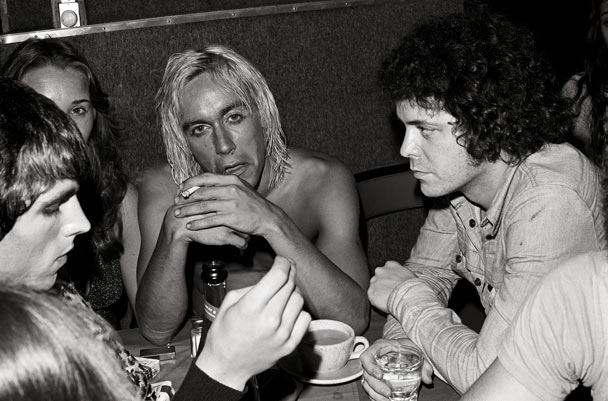
Revisiting Max’s, Sanctuary for the Hip


Monday, 27 September 2010

Twitter feeds and blogs tell hidden story of Mexico's drug wars

Netanyahu urges talks as Israel settlement freeze ends

Building materials at a construction site for a housing project in the West Bank Jewish settlement of Ariel. Photo: 26 September 2010 
Israel's PM Benjamin Netanyahu has urged the Palestinians to continue peace talks despite an end to Israel's ban on West Bank settlement-building.
In a statement moments after the end of the 10-month partial freeze, he asked Palestinian leader Mahmoud Abbas to continue seeking a "historic" deal.
Hours later, bulldozers were reported to have begun work in two settlements.
Mr Abbas had warned that peace talks would be a "waste of time" unless the freeze was extended.
Construction work
Israeli media said bulldozers had started levelling ground for 50 homes in the settlement of Ariel in the northern West Bank.
However, construction work was expected to be slow because of the Jewish holiday of Sukkot.
Similar activity was also reported in the settlement of Adam.
Meanwhile, the US renewed calls for Israel to maintain the construction freeze, saying its position on the issue remained unchanged and the US state department was staying "in close touch" with all parties.
US Secretary of State Hillary Clinton spoke to Mr Netanyahu and also to Tony Blair, the representative of the Middle East Quartet (the EU, Russia, the UN and US), as the end of the construction freeze neared, a spokesman said.
Israel says the settlements are no bar to continuing direct talks on key issues, and US negotiators have been working intensively to secure a deal.
On Saturday, Israeli Defence Minister Ehud Barak told the BBC he would attempt to convince government colleagues of a compromise deal, said the chances of a deal on the issue was "50/50".
Gun attack
The freeze on building in the West Bank expired at midnight local time on Sunday (2200 GMT).
Earlier in the evening, a pregnant Israeli woman and her husband were lightly wounded in a gun attack in the West Bank.
Israeli police said Palestinian gunmen opened fire on their car south of the city of Hebron. The woman later gave birth in hospital.
Meanwhile, some Jewish settlers started celebrating the end of the construction ban.
At the Jewish settlement of Revava, near the Palestinian town of Deir Itsia, reports said they released balloons and broke ground for a new nursery school before the moratorium expired.
The Israel prime minister called on the Palestinians to continue peace talks, which recently resumed after a 20-month pause and have the strong backing of US President Barack Obama.
"Israel is ready to pursue continuous contacts in the coming days to find a way to continue peace talks between Israel and the Palestinian Authority," Mr Netanyahu said in his statement.
It was possible "to achieve a historic framework accord within a year", Mr Netanyahu said.
However, his statement did not directly mention the issue of the settlement freeze.
He had earlier urged settlers "to display restraint and responsibility".
'Waste of time'
On Sunday, Mr Abbas, the Palestinian Authority president, warned that the peace talks renewed earlier this month would be futile unless the ban continued.
"If Israel does not continue the settlement freeze, the peace process will be a waste of time," the AFP news agency quoted him as saying during a visit to Paris.
Palestinian women queue to cross a checkpoint in Bethlehem, West Bank (3 Sept 2010)
However, Mr Abbas suggested that he would consult with other Arab leaders before any decision was taken. A meeting is expected in Cairo within the next 10 days.
The BBC's Wyre Davies in Jerusalem says the Palestinian leader is in a difficult position, with Israel offering few concessions, at least publicly.
If he continues negotiations, he will face accusations from his own side that the Palestinians will have backed down in the face of Israeli intransigence, our correspondent says.
It is estimated that about 2,000 housing units in the West Bank already have approval and settler leaders say they plan to resume construction as soon as possible.
The partial moratorium on new construction was agreed to by Israel in November 2009 under pressure from Washington.
It banned construction in the West Bank, occupied by Israel since the Middle East war of 1967, but never applied to settlements in East Jerusalem.
US President Barack Obama has urged Israel to extend the moratorium, saying it "made a difference on the ground, and improved the atmosphere for talks".
Nearly half a million Jews live in more than 100 settlements built since Israel's 1967 occupation of the West Bank and East Jerusalem. They are held to be illegal under international law, although Israel disputes this.

Opium Made Easy

Leaving Your Mark


No, this isn’t some fancy Photoshop trick, these are real human footprints ingrained in a hardwood floor.
70 year-old Buddhist monk Hua Chi has been praying in the same spot at his temple in Tongren, China for over 20 years. His footprints, which are up to 1.2 inches deep in some areas, are the result of performing his prayers up to 3000 times a day. Now that he is 70, he says that he has greatly reduced his quantity of prayers to 1,000 times each day...
More 

Twitter has allowed us to see directly into the brain of 50 Cent. And it's not pretty

50 Cent
Does the Anglo-Saxon poetry theory make Ja Rule Grendel? … 50 Cent. Photograph: Diane Bondareff/AP
When the exciting new thing called social media first came along, it promised to do what years of reality television, forests' worth of glossy magazines and countless fish-suppers' worth of paparazzi shots failed quite to manage: it would allow celebrities to show us The Real Them.
If you ever wondered what really went on in the heads of the people you are used to goggling at on telly, you needed wonder no longer: now, thanks to the wonder of Twitter, we would be able to SEE DIRECTLY INTO THEIR BRAINS.
It seems to work; at least for celebrities who write their own tweets. You discover that Simon Pegg is funny and nice, Graham Linehan intelligent and politically conscious, William Gibson geeky and sociable, Amy Winehouse a bit erratic, and 50 Cent . . . well, you discover that 50 Cent is an absolutely epic plonker.
He is rapidly becoming a reason in himself to go on Twitter. It's grammatically haphazard – as he says: "Any sucker can press spell check" – but you tend to get the gist. "A yal be on twitter meeting each other. Then yal be fucking this shit is crazy. I wanta find me a bad bitch on twitter. Lol" is pretty much average.
In the last week or so alone he has told us about having "shaved the poodle", encouraged female followers to tweet him pictures of themselves in their bras and pants, speculated ungallantly on the private parts of other artistes (Erykah Badu's, he says cryptically, "make a nigga colour blind"), and announced the formation of a three million-strong cult led by, er, him, with sketchy proposals for a eugenic breeding programme.
A very useful supplementary feed – @English50Cent – interprets his sayings for those less with it. For instance, when Fiddy found himself having an online scrap with some pre-teen Justin Bieber fans, he tweeted: "I'm a take my belt off and beat one of you little motherfuckers were your mama and daddy at anyway bad ass kids." @English50Cent translated: "I am going to remove my trousers and attack some children."
This is all glorious in a horrifying sort of way. But is this 50 Cent making his own myth or undermining it? From time to time you can tell – or imagine you can – that a member of Fiddy's entourage has risked life and limb to physically wrest the iPhone from the boss's grip and started tweeting on his behalf.
He spells better and becomes more philosophical. "To hate me is to hate success," he says. He adds that university degrees are a better test of short-term memory than underlying intelligence. And he warns: "I do believe that a wise man who plays the part of a fool will learn faster."
Some years ago, Giles Foden was banished to Pseud's Corner when he used these pages to compare Eminem to Robert Browning. But he was on to something, really. He argued, quite reasonably, that the songs should be understood as dramatic monologues: Slim Shady's antisocial tendencies are no more reflective of Marshall Mathers's true feelings than the wife-murdering narrator of My Last Duchess reflected those of Browning, in real life uxorious to a fault.
Pop music has always been about projecting a persona as much as about putting over a song, and this goes double for rap. My theory is that you need to look further back than the Victorians, though: gangsta rap is basically Anglo-Saxon heroic poetry, only with phat beatz instead of fat Geats.
In gangster rap, as in Anglo-Saxon verse, you've got a poem or song – semi-improvisational, sound-patterned with rhyme or alliteration – designed to inflate an already preposterous reputation. The archetypal hero is a boastful fellow, distinguished by three things: being able to drink more mead (or smoke more weed) than everyone else, amass more gold (bling) than everyone else, and kill more enemies in fights than everyone else.
The Anglo-Saxon poet, arguably, was a little more respectful of women and less likely to insert the disclaimer "no homo" into an account of male companionship than his modern-day heirs, but the point basically holds.
What effect does social media have on the process? Deflationary, I think. The Beowulf poet wrote in the third person, but 50 Cent does so in the first. Beowulf had a scop (poet) to mediate his great deeds to posterity; Twitter goes out direct.
Does a Twitter feed ironise the image created by artist and record company, then? Is Fiddy the philosopher-king, Fiddy the Bieber-basher or Fiddy the poodle-shaver the real one? Far from allowing us to see directly into his brain, we may be no closer to knowing the real 50 Cent after all. But we feel we are, and that's somehow diminishing.
"Hwaet!" is what Beowulf would have tweeted to his adversary. "@grendelsmom I'm a beat you lol." Lol perhaps, but on balance the original has more oomph.
Sam Leith @'The Guardian'

Well they would, wouldn't they?


(Thanx Stan!)

Girlz With(out) Gunz # 127

The former guerrilla set to be the world's most powerful woman

U.S. Is Working to Ease Wiretaps on the Internet

Christine O'Donnell: 'If evolution is real why are there still monkeys?' Well Christine, education is real and there are still morons

Collage by Mark Boellaard

Daniel Lanois on the making of Neil Young's new album

The Python's Dinner

python-panoram-584-1278600808.jpg

HA Fugn HA!

Sunday, 26 September 2010

Barak says West Bank settlement deal has '50-50' chance

♪♫ Kazumasa Hashimoto - There's Gold Everywhere