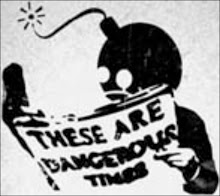
Monday, 7 November 2011


Tricky Dicky says:

Over the years, historians and philosophers have continually debated about the roots of American greatness. There are almost as many theories as there have been scholars, but a single theme recurs again and again. It is the theme of individual dignity and individual rights--an ideal that permeates the Constitution's Bill of Rights and has been a fundamental part of American life since the founding of our Nation.
Generation after generation, we find America's best minds and greatest leaders emphasizing the need to protect the rights of the individual. In the Federalist Papers, James Madison said that the twin duties of enlightened government were "to secure the public good" and to secure "private rights." In our own time, President Eisenhower reaffirmed that ideal. He said, "The supreme belief of our society is in the dignity and freedom of the individual."
In James Madison's day, the American Revolution was fought to establish a new nation based on this principle. By the time Dwight Eisenhower was President, America had passed through a tragic civil war and two bloody World Wars fought in defense of the same principle. But it is not on the battlefield alone that individual liberties are threatened and must be defended. In peace as well as in war, social, economic, political, and technological forces are constantly at work that can either help or hinder the individual American's quest for "life, liberty and the pursuit of happiness."
Many things are necessary to lead a full, free life--good health, economic and educational opportunity, and a fair break in the marketplace, to name a few. But none of these is more important than the most basic of all individual rights, the right to privacy. A system that fails to respect its citizens' right to privacy fails to respect the citizens themselves.
There are, of course, many facts which modern government must know in order to function. As a result, a vast store of personal data has been built up over the years. With the advent of the computer in the 1960's, this data gathering process has become a big business in the United States--over $20 billion a year--and the names of over 150 million Americans are now in computer banks scattered across the country.
At no time in the past has our Government known so much about so many of its individual citizens. This new knowledge brings with it an awesome potential for harm as well as good--and an equally awesome responsibility on those who have that knowledge. Though well-intentioned, Government bureaucracies seem to thrive on collecting additional information. That information is now stored in over 7,000 Government computers. Collection of new information will always be necessary. But there must also be reasonable limits on what is collected and how it is used.
The same process has been at work in the private sector where computers and modern data technology have placed vast quantities of personal information in the hands of bankers, employers, charitable organizations, and credit agencies.
On the positive side, the availability of this information serves us all in many important ways.
Without computer technology, it would, for example, be almost impossible to process and deliver 27 million social security checks every month, to send out veterans benefits, to ensure that Medicare payments are properly made.
Law enforcement agencies would not and could not combat new and sophisticated criminal activities without the use of the latest technical developments in the data field, whether in helping to trace stolen goods or in helping to track down and identify criminals.
In the private sector, the banking industry could not even start to cope with the vast volume of personal checks which are issued and cashed daily without using computer technology.
No modern industrial society can survive without computers and data processing-and especially a society with high living standards and even higher expectations such as ours.
Many of the good things in life that Americans take for granted would be impossible, or impossibly high-priced, without data retrieval systems and computer technology. But until the day comes when science finds a way of installing a conscience in every computer, we must develop human, personal safeguards that prevent computers from becoming huge, mechanical, impersonal robots that deprive us of our essential liberties.
Here is the heart of the matter: What a person earns, what he owes, what he gives to his church or to his charity is his own personal business and should not be spread around without his consent. When personal information is given or obtained for one purpose, such as a loan or credit at a store, it should not be secretly used by anyone for any other purpose.
To use James Madison's terms, in pursuing the overall public good, we must make sure that we also protect the individual's private rights. There is ample evidence that at the present time this is not being adequately done. In too many cases, unrestricted or improper use of personal information is being made.
In some instances, the information itself is inaccurate and has resulted in the withholding of credit or jobs from deserving individuals. In other cases, obsolete information has been used, such as arrest records which have not been updated to show that the charges made against an individual were subsequently dropped or the person found innocent. In many cases, the citizen is not even aware of what information is held on record, and if he wants to find out, he either has nowhere to turn or else he does not know where to turn.
Whether such information is provided and used by the government or the private sector, the injury to the individual is the same. His right to privacy has been seriously damaged. So we find that this happens sometimes beyond the point of repair. Frequently, the side effect is financial damage, but it sometimes goes further. Careers have been ruined, marriages have been wrecked, reputations built up over a lifetime have been destroyed by the misuse or abuse of data technology in both private and public hands.
It is clear, as one Government study has concluded, that "it is becoming much easier for record-keeping systems to affect people than for people to affect record-keeping systems." Fortunately, more and more people are becoming aware of this growing threat.
The Fair Credit Reporting Act of 1970, which I signed into law, took a major first step toward protecting the victims of erroneous or outdated information. It requires that an individual be notified when any adverse action, such as denial of credit, insurance, or employment, is taken on the basis of a report from consumer reporting agencies. It also provides citizens with a method of correcting these reports when they do contain erroneous information.
Many public and private statistical organizations which collect personal data have shown an awareness of their own responsibility to prevent unfair disclosure and to eliminate inaccurate or obsolete information.
Earlier this month, Attorney General Saxbe proposed legislation to the Congress which would establish rules governing the collection and use of criminal justice information, and the Congress itself has conducted extensive hearings into the uses and the abuses of data banks, credit bureaus, and personal records.
All of this is action in the right direction, but we must go further and we must move quickly.
What was once a minor problem affecting only a small number of people has now become a national problem that could potentially affect every American with a charge account, a service or personnel record, a credit card, a social security number, a mortgage, or an appliance or automobile bought on time. In short, data banks affect nearly every man, woman, and child in the United States today.
To meet a challenge of these dimensions, we need more than just another investigation and just another series of reports. We need action. That is why I am today establishing in the White House a top priority Domestic Council Committee on the Right of Privacy. This will not just be another research group. It will be a panel of some of the most able men and women in the Government, and it will be primed for high-level action.
It will be chaired by Vice President Ford. It will include the Attorney General and five other Cabinet members--the Secretaries of the Treasury, Defense, Commerce, Labor, and Health, Education, and Welfare--along with the Chairman of the Civil Service Commission, the Director of the Office of Management and Budget, the Director of the Office of Consumer Affairs, and the Director of the Office of Telecommunications Policy.
This is no ordinary group, and the task I have set for it is no ordinary task.
This Privacy Committee will build on the fine work that other groups have already carried out, and I will see to it that it is supported by the best talent available in determining the views of representatives from the legislative branch, the judicial branch, and the private sector, including our colleges and universities.
I am asking the members to examine three key areas of concern: collection, storage, and use of personal data. Specifically, the committee will examine:
--How the Federal Government collects information on people and how that information is protected;
--Procedures which would permit citizens to inspect and correct information held by public or private organizations;
--Regulations of the use and dissemination of mailing lists;
--And most importantly, ways that we can safeguard personal information against improper alteration or disclosure.
All of this will require extensive work by the Committee, but it is only the first half of the job.
Once the information and views of all parties concerned have been thoroughly aired, the Committee will be responsible for developing a comprehensive series of specific recommendations for action. I want that action to provide a personal shield for every American, which he can use to protect his right to privacy.
I am directing this blue-ribbon panel, within 4 months, to begin providing a series of direct, enforceable measures-including regulations, executive actions, policy changes, legislation where necessary, and voluntary restraints--all of which we can immediately begin to put into effect.
Advanced technology has created new opportunities for America as a nation, but it has also created the possibility for new abuses of the individual American citizen. Adequate safeguards must always stand watch so that man remains the master-and never becomes the victim--of the computer.
In the first half of this century, Mr. Justice Brandeis called privacy the "fight most valued by civilized men." In the last half of this century, we must also make it the right that is most protected.
Thank you and good afternoon.
Meth Labs Get Smaller and Easier to Hide
Methamphetamine is increasingly being made in the United States in small labs that are easy to move and hide, The Wall Street Journal reports.
These “one-pot” labs use a two-liter soda bottle and ingredients that can be bought through a single trip to a pharmacy. These small labs are spreading at a time when budget cuts are reducing police forces, making it more difficult for police to close down these labs.
Although the labs only produce small amounts of meth, they are toxic and highly explosive, and can cause fires and deaths. Incidents related to meth production increased to 11,239 last year, after falling to 6,095 in 2007, according to the Drug Enforcement Administration.
The growth of small meth labs has prompted some states to propose bills that would require a doctor’s prescription for over-the-counter cold medicines that contains pseudoephedrine, the main ingredient in meth. Such laws already have been passed in Oregon and Mississippi.
Drug manufacturers are financing a national tracking network to monitor pseudoephedrine sales. So far 17 states have signed up. After federal regulations began to limit over-the-counter sales of pseudoephedrine to a few grams a day in 2006, meth producers began scaling down recipes so that just a few cold medicine packages are needed.
In many states, agencies have had to abandon tactics to confront meth manufacturers, after the federal government in February canceled a program that provided $19.2 million in 2010 to assist local agencies in disposing of meth labs.
Specialized training is needed to clean up meth labs, because making meth requires dangerous ingredients including ammonia, battery acid and drain cleaner. The waste cannot be discarded in a regular landfill.
@'Drugfree.org'
These “one-pot” labs use a two-liter soda bottle and ingredients that can be bought through a single trip to a pharmacy. These small labs are spreading at a time when budget cuts are reducing police forces, making it more difficult for police to close down these labs.
Although the labs only produce small amounts of meth, they are toxic and highly explosive, and can cause fires and deaths. Incidents related to meth production increased to 11,239 last year, after falling to 6,095 in 2007, according to the Drug Enforcement Administration.
The growth of small meth labs has prompted some states to propose bills that would require a doctor’s prescription for over-the-counter cold medicines that contains pseudoephedrine, the main ingredient in meth. Such laws already have been passed in Oregon and Mississippi.
Drug manufacturers are financing a national tracking network to monitor pseudoephedrine sales. So far 17 states have signed up. After federal regulations began to limit over-the-counter sales of pseudoephedrine to a few grams a day in 2006, meth producers began scaling down recipes so that just a few cold medicine packages are needed.
In many states, agencies have had to abandon tactics to confront meth manufacturers, after the federal government in February canceled a program that provided $19.2 million in 2010 to assist local agencies in disposing of meth labs.
Specialized training is needed to clean up meth labs, because making meth requires dangerous ingredients including ammonia, battery acid and drain cleaner. The waste cannot be discarded in a regular landfill.
@'Drugfree.org'

The Man Who Made the Title Sequence Into a Film Star
While he was browsing in the bargain bin of a book store on Third Avenue in Manhattan, the young graphic designer Saul Bass was struck by the spiraling images in a book about the 19th-century French mathematician Jules-Antoine Lissajous. He bought the book and experimented with ways of replicating those spirals. “I made a batch. Sat on them for years,” Bass recalled. “And then Hitchcock asked me to work on ‘Vertigo.’ Click!”
Alfred Hitchcock had commissioned him to design the title sequences for his 1958 psychological thriller “Vertigo.” Bass chose the spiraling forms in the Lissajous book as his main motifs, knowing that they would reflect the frenzied tension of the plot. Beginning with an extreme close-up of a woman’s face as the screen is soaked in a bloody shade of red, his opening titles ended with a dizzying spiral fading into an eye.
It is very rare for a designer to be as revered in his field as Bass is in film graphics. The titles he devised for directors such as Stanley Kubrick, Otto Preminger, Martin Scorsese, Billy Wilder and Hitchcock transformed what were once cursory lists of the cast and crew into thrilling complements to the movies. “The great thing in working with Saul,” said the composer Elmer Bernstein, “is that your music never got a better break.”
So accomplished were Bass’s titles that when a colleague suggested to Mr. Scorsese that they should commission him to work on the film “Goodfellas,” he replied: “Do we dare?” Luckily they did. But Bass’s dazzling work in film has obscured his other achievements as one of the most prolific graphic designers of the late 20th century. The first major book on his work, “Saul Bass: A Life in Film and Design,” by his daughter Jennifer Bass and the design historian Pat Kirkham, redresses the balance by analyzing an eclectic career that also included the design of corporate identities, gas stations, record and book covers, children’s toys and a postage stamp.
Witty, gregarious and intellectually inquisitive, Bass executed each project in a seemingly simple, yet expressive style that reflected his fascination with constructivism, modernism and surrealism. In the book, Mr. Scorsese describes his designs as having “found and distilled the poetry of the modern, industrialized world...”

Continue reading
Alice Rawsthorn @'NY Times'

Oban fireworks fiasco
Via Oban Times:
A technical hitch saw Oban’s community fireworks all released at the same time at Mossfield Stadium tonight,November 4 2011.
The display,which usually lasts around half an hour,barely lasted a minute as a spectacular number of fireworks went off simultaneously. After a minute of darkness,Councillor Roddie McCuish,one of the members of the organising committee,had to apologise and tell the crowd of hundreds who had gathered to watch the annual fireworks,that it was all over.
A technical hitch saw Oban’s community fireworks all released at the same time at Mossfield Stadium tonight,November 4 2011.
The display,which usually lasts around half an hour,barely lasted a minute as a spectacular number of fireworks went off simultaneously. After a minute of darkness,Councillor Roddie McCuish,one of the members of the organising committee,had to apologise and tell the crowd of hundreds who had gathered to watch the annual fireworks,that it was all over.
Free show after Oban fireworks fiasco
Scott Campbell shot by police with rubber bullet at Occupy Oakland
While filming a police line at Occupy Oakland after midnight on Nov. 3 following the Nov. 2 general strike, an officer opens fire and shoots me with a rubber bullet. I was standing well back. There was no violence or confrontations of any kind underway. At 0:31 seconds you can see a tall officer in the front raise his weapon and then fire. This is the full clip of the incident.

Afghanistan – touch down in flight
Info
I used to know lots of people who had been to Afghanistan and said it was the most beautiful country they had ever seen...
Subscribe to:
Comments (Atom)