Wednesday, 4 May 2011

Why the truth will out but doesn’t sink in

Bin Laden used a woman as a human shield and fired at the commando team sent to kill him – at least according to the first reports. These have just been corrected to say he was unarmed and standing alone, but the retractions follow a useful pattern – media friendly version first, accurate version later – because the updates make little impact on our beliefs.
In this particular case, I can’t speculate why the corrections came as they did. Maybe it was genuinely the ‘fog of war’ that led to mistaken early reports, but the fact that the media friendly version almost always appears first in accounts of war is likely, at least sometimes, to be a deliberate strategy.
Research shows that even when news reports have been retracted, and we are aware of the retraction, our beliefs are largely based on the initial erroneous version of the story. This is particularly true when we are motivated to approve of the initial account.
Psychologist Stephan Lewandowsky has been studying this effect for several years and not just with abstract test material. Here’s a summary of his study study on retracted reports of the Iraq war:
Media coverage of the 2003 Iraq War frequently contained corrections and retractions of earlier information. For example, claims that Iraqi forces executed coalition prisoners of war after they surrendered were retracted the day after the claims were made. Similarly, tentative initial reports about the discovery of weapons of mass destruction were all later disconfirmed.
We investigated the effects of these retractions and disconfirmations on people’s memory for and beliefs about war-related events in two coalition countries (Australia and the United States) and one country that opposed the war (Germany). Participants were queried about (a) true events, (b) events initially presented as fact but subsequently retracted, and (c) fictional events.
Participants in the United States did not show sensitivity to the correction of misinformation, whereas participants in Australia and Germany discounted corrected misinformation. Our results are consistent with previous findings in that the differences between samples reflect greater suspicion about the motives underlying the war among people in Australia and Germany than among people in the United States.
More recent studies have supported the remarkable power of first strike news. The emotional impact of the first version has little influence on its power to persuade after correction, and the misinformation still has an effect even when it is remembered more poorly than the retraction.
Even explicitly warning people that they might be misled doesn’t dispel the lingering impact of misinformation after it has been retracted.
So while the latest reports say Bin Laden was alone and unarmed, the majority of people are likely to believe he was firing from behind a human shield, even when they can remember the corrections.
And if this isn’t being used as a deliberate strategy to manage public opinion, I shall eat my kevlar hat.
Vaughn Bell @'Mind Hacks'

Osama bin Laden: US responds to questions about killing's legality

How to buy 'No Wave' (Mojo June 2011)

Indebted as much to free jazz as punk-rock, and closely related to the mid-'70s East Village avant-garde New Cinema scene which revered director Jean-Luc Godard's dictum that "there are no new waves, only the ocean", no wave music emerged from the dripping lofts and performance art spaces of Lower Manhattan in 1971, offering an abrasive, nihilist rejoinder to perky new wave rock. The scene's gate openers were Suicide, purveyors of heroically confrontational downtown art-noise epiphanies since the early '70s. Like Suicide, no wave musicians were largely autodidacts - their predilection for texture over melody and disavowal of blues-based worthiness matched by lyrics of unabashed psychic torment.
No wave's fire burnt intensely, if briefly, wafted by émigré Brian Eno after he'd witnessed the cavalcade of visceral art screamers and jazz-punk tyros who graced New York, New York, a five-day 'noise festival' staged at SoHo's Artists Space gallery in May 1978. Inspired, Eno convinced Island Records to invest in a vinyl showcase for this latest incarnation of Gotham underground desecration and so the seminal No New York album was born, Eno producing the cream of the acts. Although dismayed by the jarring, clamourous results, Island released the album in 1978, enshrining the no wave 'moment' and catapulting the careers of hitherto obscure scenesters like Lydia Lunch, Arto Lindsay and James Chance.
No wave's mayfly heyday bequeathed a mere smattering of essential waxings - though subsequent anthologising would turn up a wealth of fiercely uncompromising music - but its influence is conspicuous in everything from Sonic Youth to The Birthday Party,The Pop Group and even Riot Grrrl.
10 VARIOUS N.Y. No Wave
Restricting itself only to tracks recorded for the Ze label, and with an erroneous subtitle, The Ultimate East Village '80s Soundtrack (many of its tracks in fact date from the late '70s), this is still a useful, if by no means definitive, introduction to no wave, proffering key tracks by Mars, Teenage Jesus And The Jerks, The Contortions, etc, alongside interesting, if arguably post-no wave cuts, from Lydia Lunch's Queen Of Siam solo debut and Arto Lindsay and cinematographer Seth Tillett's spoken-word project, Arto/Neto. lt also finds room for avant-funk tracks by French chanteuse/guitarist Lizzy Mercier Descloux.
9 GLENN BRANCA Songs '77-'79
String-terrorising composer Branca had worked with Rhys Chatham's Guitar Trio project before coming to prominence in two late-'70s bands, Theoretical Girls and The Static, documented here. Omitted from the No New York compilation (DNA's mischievous Arto Lindsay having convinced Eno to overlook his downtown rival), Theoretical Girls were critical no-wave scenesters despite only releasing a solitary single. This anthology exhumes their convulsive, unreleased recordings and live tracks alongside densely strummed essays by The Static, featuring Barbara Ess (of no wavers Y Pants).
8 JAMES WHITE AND THE BLACKS Off White
Lounge-suited, sax-toting James Siegfried (aka White, Chance, etc) was Lydia Lunch's erstwhile paramour and co-founder of the elemental Teenage Jesus And The Jerks, although actually schooled in free jazz and abetted by atypically adroit instrumentalists, The Blacks, AKA The Contortions, whose debut Buy also appeared in 1979. The marginally less frenetic Off White still lurches merrily from the cathartic (art-funk-disco cri de coeur Contort Yourself) to the bizarre (Stained Sheets, essentially a dirty phone call between White and Lunch).
7 GLENN BRANCA Lesson No.1
Lesson No.1 was evidence of the more structured compositional work Branca had commenced while helming Theoretical Girls. Originally issued as a twelve-inch mini-LP featuring two extended instrumental tracks, the aggressive, self-explanatory Dissonance and the more accessible title track (influenced by Joy Division's Love Will Tear Us Apart and featuring one Harry Spitz on sledgehammer), this reissue boasts a third track, the metallically textured Bad Smells, essayed by a larger guitar ensemble whose numbers include a pre-Sonic Youth Thurston Moore and Lee Ranaldo.
6 SUICIDE Suicide
In the words of Glenn Branca: "If you have to find out who the godfather of no wave was, it was Alan Vega. He was doing no wave years before any of us." Indeed, Suicide's sometime light sculptor frontman, along with keyboardist partner Martin Rev, had been delivering antagonistic yet transcendent aural assaults on downtown New York audiences for several years before no wave struck. While this, their debut album, would influence a legion of subsequent synth duos, Suicide's eerily distorted, shimmering songs, and Vega's uncompromising attitude made them equally crucial no wave progenitors.
Brazilian-born Arto Lindsay, DNA's gaunt, bespectacled frontman, was, and remains, a downtown prime mover. His first band was arguably no wave's most explosive. Backed by untrained female Japanese drummer lkue Mori and performance-artist-turned-keyboardist Robin Lee Crutchfield (later replaced by Pere Ubu bassist Tim Wright), Lindsay's primal scream vocals - partly delivered in fractured Portuguese - were matched by the white-noise detonations he conjured from a randomly detuned Danelectro twelve-string guitar. DNA On DNA collates the band s modest studio repertoire plus grainy live recordings.
Mars were the no wavers who came closest (relatively speaking) to rock orthodoxy - their heavily textured sound an augury of early Sonic Youth and effectively a blueprint for post-punk. Formed in 1975 by vocalist Sumner Crane and guitarist/singer China Burg, the quartet (completed by bassist Mark Cunningham and drummer Nancy Arlen) committed only eleven songs to tape during their three-year existence and played fewer than thirty gigs, none outside New York. This set collects the lot, including the compelling, insectoid Helen Forsdale.
3 JAMES CHANCE & THE CONTORTIONS Buy
Released almost simultaneously with James White And The Blacks' Off White (and featuring ostensibly similar personnel), The Contortions' full debut is an enduring no wave benchmark, its paroxysms of warped funk-rock and yelping free-jazz straddling the chasm between Richard Hell's Voidoids and Albert Ayler. Chance decants his volatile, agitated persona into a dozen squirming, nihilist titles like I Don't Want To Be Happy and Contort Yourself (a veritable no wave standard, also recorded by The Blacks), as the uncredited Contortions squirm on.
2 TEENAGE JESUS AND THE JERKS Shut Up And Bleed
Notorious for ten-minute sets, and creators of a mere handful of EPs during their lifespan, Teenage Jesus And The Jerks were propelled into the spotlight by their feral, needle-sharp contributions to the No New York anthology, securing the iconic status of Medusa-like teenage leaderene Lydia Lunch (plus future Bad Seeds/Grinderman drummer Jim Sclavunos). Shut Up And Bleed corrals the band's entire oeuvre (alongside tracks by the subsequent Beirut Slump), including the malevolent narratives of Baby Doll, Orphans, et al.
1 VARIOUS No New York
Fresh from producing new wave's artier outriders, Devo and Talking Heads, curator Eno whittled down a long list of NYC "research bands" to just four for this seminal compilation, applying an uncharacteristic hands-off approach to the production of primal, art-rock deconstruction from Mars and DNA; self-styled 'aural terror' from Teenage Jesus And The Jerks; and squealing, rudimentarily miked punk-jazz from The Contortions. Released by Island's esoteric Antilles imprint, the lyrics printed, with apposite wilfulness, on the inaccessible inside of the outer sleeve, No New York was the genre's definitive document and remains an ideal entry portal for the no wave ingénue.
AVOID THESE!
No wave was so fleeting that anything produced during its succinct heyday is worthy of investigation. The Manhattan-centric tendency did Produce some questionable responses in the remainder of the US underground, however. Not least was a 1979 No New York retort entitled Yes L.A., released by Californian punk imprint Dangerhouse. A limited edition one-sided LP boasting tracks by X, The Germs and other CA new wave stalwarts, its sleeve bore the petulant disclaimer "Not produced by Brian Eno". Caveat emptor: this now expensive collector's item reveals only that the sound of the '79 West Coast underground was rock'n'roll cheese to New York's art-music chalk.
Via

FBI warns that fake bin Laden video is a virus

he U.S. Federal Bureau of Investigation warned computer users Tuesday that messages claiming to include photos and videos of Osama bin Laden's death actually contain a virus that could steal personal information. The warning comes as security companies said that they've spotted the first samples of malicious software disguised as photos of the dead Al Qaeda leader.
Security vendor F-Secure said Tuesday that criminals are e-mailing a password-stealing Trojan horse program called Banload to victims, and Symantec said it's seen criminals spamming victims with links to fake "Osama dead" news articles that launch Web-based attacks on visitors.
U.S. authorities do have photos of bin Laden, who was shot in the head during an early morning raid Monday in Pakistan. But these photos have not been released publicly.
Scammers have also used a technique called search engine poisoning to try to trick search engines into listing hacked Web pages that are loaded with malware in their search results. "It's unlikely you'll find pictures or videos of Bin Laden's death online -- but searching for one will certainly take you to sites with malware," wrote F-Secure chief research officer Mikko Hyponnen in a blog post.
The FBI warned Internet users to watch out for fake messages on social network sites and to never download software in order to view a video. "Read e-mails you receive carefully. Fraudulent messages often feature misspellings, poor grammar, and non-standard English," the FBI warning stated.
As a major international news event, bin Laden's death has shown the amazing way information can spread online. Many learned of the terrorist leader's death through Twitter, where the story first broke, or Facebook. But it also underscores how the unfiltered media can quickly spread bad information worldwide.
In the two days since the early morning raid, the bin Laden story has generated fake photographs, fake quotes, and plenty of scams.
Security experts said that shady marketers and so-called rogue antivirus vendors have also jumped on the bin Laden bandwagon. The rogue antivirus software bombards victims with pop-up messages telling them they have a computer problem. Its aim: to nag them into paying for bogus software.
Shady marketers are spreading messages on Facebook that try to lure victims into spreading the message to friends and visiting marketing Web sites, by claiming they have a censored video.
"Osama is dead, watch this exclusive CNN video which was censored by Obama Administration due to level of violence, a must watch," is a typical lure used in the scam. Users are encouraged to cut and paste malicious JavaScript code into their browser, which then sends the message to all of their Facebook friends. Security experts say never to cut and paste scripts into the browser.
Robert McMillan @'ComputerWorld'

Flairs - Trucker's Delight

Wikileaks: US Told Kiwis “We’ll Fund Piracy Crackdown”

Wikileaks reveals tense relations between Pakistan and US

A Guide to Beck and Scientology

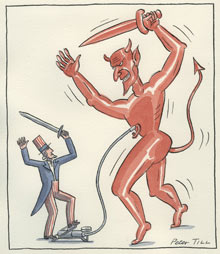
Adam Curtis: For 10 years, Osama bin Laden filled a gap left by the Soviet Union. Who will be the baddie now?

Peter Till 
The horrific thing about Osama bin Laden was that he helped to kill thousands of innocent people throughout the world. But he was also in a strange way a godsend to the west. He simplified the world. When communism collapsed in 1989, the big story that had been hardwired into citizens of western countries – that of the global battle against a distant dark and evil force – came to an abrupt end. Understanding the world became much more complicated until, amid the confusion of a global economic crisis in 1998 and the hysterical spectacle of the Monica Lewinsky affair, Bin Laden emerged as the mastermind behind the bombings of embassies in east Africa.
President Clinton immediately seized on it. He fired off cruise missiles, they missed, and everyone accused Clinton of using Bin Laden to take the heat off himself. But if you look back at some of the pieces television reporters did that day in Washington, you can see something else too: the murky shape of an old story slowly re-emerging, like a wreck rising up from the sea.
Bin Laden and his ideological mentor, Ayman al-Zawahiri, talked about "the near enemy" and the "far enemy". But from 2001 onwards they became America's "far enemy". Neoconservative politicians, who had last tasted real power under President Reagan during the cold war, took the few known facts about Bin Laden and Zawahiri and fitted them to the template they knew so well: an evil enemy with sleeper cells and "tentacles" throughout the world, whose sole aim was the destruction of western civilisation. Al-Qaida became the new Soviet Union, and in the process Bin Laden became a demonic, terrifyingly powerful figure brooding in a cave while he controlled and directed the al-Qaida network throughout the world. In this way, a serious but manageable terrorist threat became grossly exaggerated.
Journalists, many of whom also yearned for the simplicity of the old days, grabbed at this: from the outset, the reporting of the Islamist terror threat was distorted to reflect this dominant simplified narrative. And Bin Laden grabbed at it too. As the journalists who actually met him report, he was brilliant at publicity. All three – the neoconservatives, the "terror journalists", and Bin Laden himself – effectively worked together to create a dramatically simple story of looming apocalypse. It wasn't in any way a conspiracy. Each of them had stumbled in their different ways on a simplified fantasy that fitted with their own needs.
The power of this simple story propelled history forward. It allowed the neocons – and their liberal interventionist allies – to set out to try to remake the world and spread democracy. It allowed revolutionary Islamism, which throughout the 1990s had been failing dramatically to get the Arab people to rise up and follow its vision, to regain its authority. And it helped to sell a lot of newspapers.
But because we, and our leaders, retreated into a Manichean fantasy, we understood the new complexities of the real world even less. Which meant that we completely ignored what was really going on in the Arab world.
As journalists and Predator drones searched for the different al-Qaida "brands" across the regions, and America propped up dictators who promised to fight the "terror network", a whole new generation emerged in the Middle East who wanted to get rid of the dictators. The revolutions that this led to came as a complete shock to the west. We have no idea, really, who the revolutionaries are or what, if any, ideologies are driving them. But it is becoming abundantly clear that they have nothing to do with "al-Qaida". Yet ironically they are achieving one of Bin Laden's main goals – to get rid of the "near enemy", dictators such as Hosni Mubarak.
One of the main functions of politicians – and journalists – is to simplify the world for us. But there comes a point when – however much they try – the bits of reality, the fragments of events, won't fit into the old frame.
The death of Bin Laden may be that point for the simplified story of goodies versus baddies. It was a story born in the US and Britain at the end of the second world war – the "good war". It then went deep into the western imagination during the cold war, was reawakened and has been held together over the last 10 years by the odd alliance of American and European politicians, journalists, "terror experts" and revolutionary Islamists all seeking to shore up their authority in a disillusioned age.
Barack Obama seems to be rejecting this story already. The Europeans still cling to it, though, with the return of "liberal interventionism" in Libya, but it is anxious and halfhearted.
But it is in Afghanistan that the story is really falling apart. We are beginning to realise that this simplification has led to completely unreal fantasies about who we are really fighting. Fantasies that only persist because they justify our presence there. For the fundamental problem with this simple story of good versus evil is that it does not permit a proper critical framework that allows you to properly judge not only those you are fighting, but also your allies.
America and the coalition invaded Afghanistan with the simple aim of destroying the terror camps and setting up a democracy that would allow the country to be ruled by good people. But in the ensuing decade they have been tricked, spun round and deceived by the complex web of vested interests there. And their inability to understand and deal with this has led to the rise of a state crippled by corruption in which it is impossible to know who the "good" people might be any longer.
Meanwhile President Harmid Karzai has immediately pointed out that Bin Laden's killing proves that the real terrorist threat is in Pakistan – and the fight against terror in his country is a fantasy. But we also know that much of what Karzai says may also be the fantasies he uses to justify the growing power of the small elite around him. And so Afghanistan becomes a hall of mirrors – except the one thing everyone agreed on was that Bin Laden wasn't there.
With Bin Laden's death maybe the spell is broken. It does feel that we are at the end of a way of looking at the world that makes no real sense any longer. But the big question is where will the next story come from? And who will be the next baddie? The truth is that the stories are always constructed by those who have the power. Maybe the next big story won't come from America. Or possibly the idea that America's power is declining is actually the new simplistic fantasy of our age.
@'The Guardian'

BBC: al Qaeda Does Not Exist

Tuesday, 3 May 2011

The cost of Osama bin Laden

Julian Assange is in exile

Assange Claims Automated Intelligence Gathering on Facebook

Rewind: Obama '07 'lowest' point on Pakistan was actually prescient

X

Obama and the End of Al-Qaeda
