Monday, 7 March 2011

After Patricia (Highsmith)

Let’s be honest.
I rue the day I didn’t have my late stepmother whacked.
I’d rather eat dirt than talk to my larcenous cousins.
I haven’t forgiven my father for disinheriting me.
I don’t like families...
 Continue reading
Joan Schenkar @'The Paris Review'

Iran's supreme leader accused of abducting key opponents

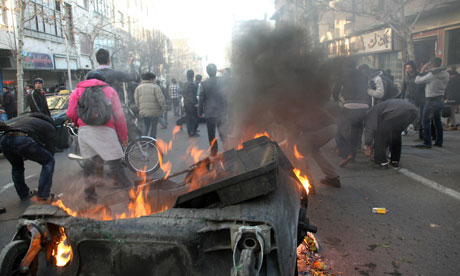
Iranian protesters attending an anti-government protest in Tehran
Iranians attending an anti-government protest in Tehran. Green movement leaders have not been seen in public since being put under house arrest. Photograph: AP
Iran's supreme leader, Ayatollah Ali Khamenei, was directly involved in the disappearance of the two main leaders of the Green movement, an opposition website has claimed.
Mehdi Karroubi and Mir Hossein Mousavi have not been seen in public since being put under house arrest following renewed street protests in mid-February when thousands of Iranians, inspired by the uprisings in the Arab region, took to the streets in defiance of warnings from the regime. They are believed to have been arrested on 26 February.
Karroubi's official website, Sahamnews.net, said Khamenei had ordered what it described as "the abduction of Karroubi and his wife, Fatemeh".
The site said Khamenei's administrative adviser, Vahid Haghanian, commanded the security forces which raided Karroubi's house in north Tehran and confiscated his belongings.
"On the night of the kidnapping, Vahid, a top official in the supreme leader's office, was present in Mr Karroubi's house and he personally commanded the whole operation of evicting Mr Karroubi and his wife from their own house and taking them to an unknown location," the website said.
"We believe that the supreme leader himself is responsible for this kidnapping and Vahid was appointed by him to carry out the operation."
The website said Haghanian advises the supreme leader on internal affairs.
Since the disappearances, Iranian officials have given vague and often contradictory statements about Karroubi, Mousavi and their wives.
A spokesman for Iran's judiciary, Gholam-Hossein Ejei, confirmed initially that restrictions had been imposed on opposition leaders but later denied they had been arrested. "Reports ... about the transfer of Karroubi and Mousavi to a prison are not correct and are rejected," he said on Tuesday last week. Tehran prosecutor Abbas Jafari Dolatabadi said talk of imprisonment was a "sheer lie" and added: "Mr Mousavi and Karroubi, along with their wives, are in their homes."
Meanwhile, Mousavi's daughters wrote on opposition website Kaleme.org that they cannot visit their parents. "We read the news that our parents are not under house arrest and they are not prisoners ... which meant that we, their children, can see them ... But this was not the case. We went to our parents' home, and from the iron gate installed at the entrance of the alley to their home we were stopped by the security, who said that 'you can't go, the news [that you can visit] is wrong'."
Karroubi's sons told Sahamnews.net that they have repeatedly visited Karroubi's house but no one was there. They also said that neighbours claim they have witnessed Karroubi and his wife being taken out of their house.
Ardeshir Amir-Arjomand, a spokesman for Mousavi, told the Guardian: "Their situation is worse than a prisoner because when someone is jailed, at least you know who has jailed him or where he has been taken to. But in the case of Karroubi and Mousavi, no one takes responsibility or even admits they have been arrested."
Rumours were rife in recent weeks that the two had been taken to Heshmatieh prison in east Tehran.

Saeed Kamali Dehghan
@'The Guardian'

♪♫ Sage Francis - Escape Artist


Bush's Interrogators Stressed Nudity

♪♫ Shack - Cup of Tea

The changing face of fame

Long time reader Dragon Horse has been generating and collecting (top row images are from Dienekes) composite image of various classes of individuals for a while now. It’s really fun to just skim through and make your own assessments (the “global face” resembles darker skinned versions of Amerasians, whose fathers were white Americans and mothers Southeast Asian, to me).
The most well known composites are of nationalities, but he’s also generated and reposted composites of other classes. For example, the average Bollywood actress is Aishwarya Rai. Not literally, but the resemblance is jaw-dropping (compare to the average Indian woman). But most interesting to me were the comparisons of American film actors, male and female, then and now (“Golden Age” vs. contemporary). I’m pretty sure you can pick out which one is which if you’re American. There seem to be two correlated trends here: 1) more feminine features for both males and females, and 2) more youthful features for both males and females. Correlated, because neoteny and masculinization seemed to generally push in opposite directions of trait value. Projecting in the future I assume that the Global Human Celebrity will converge upon a 14 year old girl?
Addendum: One difference between the “Golden Age” and modern celebrities is the attention to a rather buff physique. So though the actors of yore had more rugged faces, their physiques were often rather flabby in comparison to today’s leading men. So I might correct and assert that the future global celebrity will be a baby-faced 14 year old girl with abs to die for!
Razib Khan @'Discover'

Rattling the Cage: Tips for Israeli information warriors

Greg Barns: Assange extradition fears are real

In theory, it ought to be difficult for the Obama administration, pressured by the resurgent and bloodthirsty Right, to demand the extradition of WikiLeaks founder Julian Assange from Sweden.
But the reality is that the Swedes will succumb to political pressure and undermine or sidestep the rule of law and allow the US ‘to land their quarry’.
The claim by Assange’s legal team that one of the prime arguments against their client being extradited to Sweden to face investigation over alleged sexual assault charges is that he will end up being tortured in a high security American prison, are not simply hyperbolic advocacy.
Under Swedish law the extradition of an individual to a non-Nordic or non-European Union country can only occur if the following conditions are met.
Firstly, the principle of dual criminality applies. That is, the act or alleged crime for which extradition is requested must be equivalent to a crime that is punishable under Swedish law by a jail term of one year or more. So you can’t be extradited for traffic offences for example.
Secondly, extradition will not be granted for the prosecution of “military or political offences”.
And finally extradition will not be granted if the person being extradited runs a risk on account of his or her religious or political beliefs, or ethnic origin of being persecuted. And if he or she faces the death penalty the Swedes will not hand the person over to another state.
If it is assumed Sweden has an equivalent to an American official secrets or espionage law and therefore the issue of dual criminality is settled, the US could not possibly satisfy the Swedish government that Mr Assange would not face all manner of cruel and unusual punishment by security agencies and US police. Even keeping Mr Assange isolated from other detainees and locked in his cell for 23 hours a day - a common penal American practice - should be enough to stop Swedish cooperation in an extradition. Then there is the fact that US federal law in respect of the offences of espionage and treason both carry the death penalty as a theoretical sentence. Theoretical because there is no-one currently on death row who has been convicted of these offences. But Mr Assange’s hosting of a website which carried an unprecedented number of US government documents might have prosecutors arguing for the death penalty.
In short, it is hard to see how Sweden, acting strictly in accordance with its own laws on extradition, could contemplate acceding to any US request to hand over Mr Assange.
But Sweden’s track record in recent years in cases where extradition or forcible return to another country would result in human rights abuse is not one that would give Mr Assange any comfort.
In 2005 the European Court of Human Rights intervened to overturn a Swedish decision to deport two Syrian men, brothers, who were wanted in Syria over alleged ‘honour killings’. The Swedish authorities, having received information that the death penalty was unlikely to be imposed on the brothers, ordered that they been returned to Syria. The European Court upheld the brother’s argument that they feared persecution on return to Syria and noted that the Swedish government had been prepared to act on incomplete information and vague assurances from the Syrian embassy.
Four years earlier in December 2001, the Swedish authorities, again acting after obtaining assurances from Egypt that two asylum seekers would not be subjected to torture and would receive a fair trial, handed over Mohammed al-Zari and Ahmed Agiza, to the Americans who transferred the men to Cairo.
There is also the political overlay in the Assange case which taints the extradition process. As we saw in this country in relation to David Hicks and Mammoth Habib it did not matter what domestic or international law conventions and rules should have been applied to their cases, the overriding consideration by the Howard government was to cooperate with the Bush White House.
As Australian diplomat and writer Tony Kevin pointed out in a briefing to federal MPs last week (at which I also spoke) the current Swedish government of prime minister Fredric Reinfeldt is a centre-right coalition heeded by the Moderate Party “which has close ties with the US Republican right. Reinfeldt and Bush are friends. Reimfeldt is ideologically and personally close to the former Bush Administration”. And, Kevin noted, that Bush’s former right hand man and Republican strategist Karl Rove is a consultant to the Swedish government on political issues.
Sweden projects an image of liberalism and determined independence but it is an illusion. So the chance of Julian Assange being whisked away by CIA operatives from Sweden is a very real one. If it happens Assange will face the same fate as Hicks and Habib - physical and mental torture over a sustained period. 
Greg Barns is a barrister and writer. He is a Director of the Australian Lawyers Alliance.
@'ABC'

The Drug Czar Comes to Town and... Nothing Much Happens

WTC Attack September 11, 2001 from New York Police Helicopter

Video obtained by FOIA to NIST by an anonymous person who directed it be sent to Cryptome. Excerpt of the NIST letter.
Via

Ad break #12

Soundtrack to the MENA uprisings - Khalas Mixtape Vol 1


"In 2009, in response to Libyan leader Moammar Gadhafi’s first speech to the United Nations, a group of Libyan exiles created an organization called Khalas, which means “enough,” the goal, to bring awareness of the struggles again Libya’s dictatorial regime not only to other Libyans in the western world but to the English-speaking world at large.
In the wake of revolution in Tunisia and Egypt and protests elsewhere in North Africa and the Middle East, the Khalas team recognized one surprising common thread in the voices of discontent, rap music. Across the region, rap artists were providing the soundtrack to protests in the street. Khalas has curated a mixtape of some of the best new protest music and is now hosting the mix on its website."
- From NPR's On The Media's interview with Abdulla Darrat, one of the founders of Khalas. http://www.onthemedia.org/transcripts/2011/02/11/02 (The interview is available as a download and transcript)
"Khalas Mixtape Vol. 1 is a compilation of songs created by North African hip hop artists from Egypt, Libya, Tunisia and Algeria who have emerged as voices of recent uprisings and calls for protest. Mish B3eed, or ‘Not far,’ refers to the sense of solidarity that these youth feel across borders, the similarities of their causes and the oppressors they face, their physical proximity and the sense that our ultimate goal is within sight. Each song describes the unique circumstances of each artist’s country, carrying with it the subtleties of local dialects, but also highlights the extraordinary similarities of their struggles."
- From the official website, http://enoughgaddafi.com/
This website is down at the time I make this torrent. Hopefully it will come back up again at a later time.
FEATURED ARTISTS:
El Général [Tunisia] http://general-74.skyrock.com/ / http://www.facebook.com/general.offciel
Mr. Shooma [Tunisia] http://www.facebook.com/Shooma
Mohamed Ali Ben Jemaa [Tunisia] http://www.facebook.com/pages/Mohamed-Ali-Ben-Jemaa/41674371426
Ramy Donjewan [Egypt] http://www.facebook.com/RamyDonjwan
Ahmed Rock [Egypt] http://www.facebook.com/revolution.ahmedrock
Revolution Recordz [Egypt] http://www.facebook.com/revrecordz
Lotfi Double Kanon [Algeria] http://www.facebook.com/doublekanon
Ibn Thabit [Libya] http://www.facebook.com/pages/Ibn-Thabit/173888819302085
SOURCES AND MORE INFO:
Music and cover art in this Torrent downloaded from: http://www.bboykonsian.com/downloads/
It can also be downloaded from: http://secretarchivesofthevatican.wordpress.com/2011/02/08/north-african-revolution-hiphop/
List of artists and their websites taken from: http://shocklee.com/2011/02/khalas-mixtape-vol-1-north-african-hip-hop-artists-unite/
Another interview with Abdulla Darrat (stream, download, transcript): http://www.pri.org/arts-entertainment/north-africa-s-hip-hop-revolutionaries.html
HERE
Via

The airlines' Qaddafi problem

Prison Terminal


Prison Terminal is a feature-length documentary that breaks through the walls of one of America’s oldest maximum security prisons to tell the story of the final months in the life of a terminally ill prisoner and the trained hospice volunteers—they themselves prisoners—who care for him.
The film draws from footage shot over a six-month period behind the walls of the Iowa State Penitentiary entering the personal lives of the prisoners as they build a prison-based, prisoner-staffed hospice program from the ground up.
Prison Terminal demonstrates the fragility, as well as the holistic benefits, of a prison-based, prisoner-staffed hospice program and provides a fascinating and often poignant account of how the hospice experience can profoundly touch even the forsaken lives of the incarcerated.

Caught singing for tyrants? Don't be embarrassed. Do what 50 Cent does: embrace it

A huge source of frustration for any performing artist is that you can't choose your fans. And the more popular you get, the more likely it is you'll attract people you can't stand. Kurt Cobain so disliked the uncool non-underground types who began showing up at Nirvana gigs after the release of their debut album Bleach that he wrote the song In Bloom, which attacks an unnamed moronic jock type who dares to enjoy Nirvana's music: "He's the one who likes all our pretty songs," goes the chorus. "And he likes to sing along, and he likes to shoot his gun – but he knows not what it means."
Yeah! Take that, you mainstream douche bags! Feeling pretty stupid now, huh?
Well, no. They weren't. Partly because they knew not what it meant, but largely because Cobain foolishly gave the song a catchy melody, and then compounded this error by including it on an album of other catchy melodies called Nevermind, which became such a massive mainstream success that he never truly lived it down, at least in his own head. And it soon turned out the despised jock fan wasn't the only one prone to discharging the occasional firearm.
Still, if Cobain was tortured by the presence of the occasional macho numbskull at his gigs, imagine how awful he'd feel if he looked out and saw a member of the Gaddafi dynasty moshing to Smells Like Teen Spirit. Chances are he'd have beaten himself to death with his own guitar right there and then.
But many of the planet's current pop stars are clearly made of sterner stuff. They're so unconcerned about the suitability of their fans, they'll put on a private show for the Gaddafi clan at the drop of a hat. A hat full of money.
Now the blood's started flowing they're getting contrite about the whole thing. First Nelly Furtado outed herself, announcing on Twitter that in 2007 she'd been given $1m to perform for the Gaddafis, and was now donating the sum to charity.
Other stars who attended Gaddafi dynasty parties include Mariah Carey, Usher, Lionel Richie, and Jay-Z – who, thanks to the bad publicity, now has 100 problems.
Mr Z's wife, Beyoncé, reportedly received $2m to perform at a New Year party thrown by Hannibal Gaddafi, but subsequently gave the money to Haiti. "Once it became known that the third-party promoter was linked to the Gaddafi family, the decision was made to put that payment to a good cause," said her publicist. Fair enough. She probably didn't realise the Gaddafis were behind the bash, although her husband reportedly attended an identical party at the same venue the previous year – at which, it is claimed, Mariah Carey sang four songs in exchange for $1m. The Gaddafi link was exposed in the press at the time, but only in small-circulation newspapers such as the Sun, so it's fair to assume Beyoncé's advisers had no idea where the cash was coming from.
Libya would be a good growth market for Beyoncé, incidentally, as, thanks to the Gaddafi regime, it now contains far more Single Ladies than it used to.
Another famous star who reportedly performed for the Gaddafis is notorious pussy 50 Cent, the crybaby pant-shitting wuss whom I could definitely have in a fight. (Did you know his real name is Fifi Millicent? Don't tell him I told you, because he's terribly sensitive about it, and weeps huge cowardly tears out of his gutless baby eyes whenever it's mentioned. Also, he was born a girl.)
Fifi was paid an undisclosed sum to sing and dance like a fey little puppet in front of Mutassim Gaddafi at the 2005 Venice film festival. But while the other stars have been embarrassed by their (possibly unintentional) connection to a despotic regime, Fifi seems to have used his as the inspiration for a startlingly violent video game called 50 Cent: Blood on the Sand, released on the PS3 and Xbox 360 in 2009.
The game opens with Fifi Millicent performing a gig in an unnamed war-torn Middle Eastern country, in exchange for a $10m fee. When the mysterious promoter shows signs of not coughing up the money, Fifi and chums storm backstage, call him a "motherfucker" and shove a shotgun in his face. Terrified, he hands them a priceless Damien Hirst-style diamond-encrusted skull. Fiddy and co then bravely head for the airport in their armoured Hummers, only to be ambushed by armed insurgents. During the gunfire and confusion, a sexy woman appears from nowhere and steals the precious skull. "Bitch took my skull," whines Fifi, before embarking on an awesome odyssey of violence across the troubled Arabic nation, shooting and murdering anyone who gets in his way.
Who'd have thought someone like 50 Cent could lend his name to something so crass and stupid? It's almost as if he's an idiot. Still, perhaps openly embracing the despotic crossover in a video game is the way forward. How long before we see a game called Gaddafi Hero, in which you perform a series of upbeat numbers for Middle Eastern tyrants by pushing coloured buttons on a plastic guitar in time to the beat, while trying to drown out the nagging voice of your own conscience and the furious chants of the oppressed?
Suggested tracklisting: While My Qatar Gently Weeps; Gimme Gimme Gimme Oman After Midnight; Insane in the Bahrain; Here Comes Yemen; and 50 Ways To Libya Lover. Recommended retail price? $2m and counting.
Charlie Brookner @'The Guardian'