Monday, 28 February 2011


Libya: African mercenaries 'immune from prosecution for war crimes'

Melbourne

Cats Quote Charlie Sheen

(GB2011) The coalition has sneaked a coup on a sleeping public

As people elsewhere are killed for their belief in democracy and the rule of law, the supposed controversies of British politics inevitably rather fade. By comparison, we live in an Eden of stability, and argue over mere increments: to be getting in a lather about Cameron and Clegg can easily feel not just indulgent, but indecent.
Still, in the broadest terms, there is a tale to be told that includes Westminster as well as Tripoli and Cairo, and underlines what watershed times these are. Much of the world's current tumult is traceable to the long and tangled fall-out from the crash of 2008 (note the role of rising food prices in Middle Eastern unrest). And though most commentators seem either too polite or deluded to recognise it, the British side of this story is rapidly being revealed: not just cuts, but the most far-reaching attempt to remodel British society in 60 years, undertaken at speed, and with a breathtaking disregard for what was offered to the country only months ago. Last week, Labour MP John McDonnell wrote to the Guardian arguing that the increasing gap between claims of fiscal necessity and a transparently ideological project merited another election. It won't happen, but he has a point.
The other day, I picked up a copy of Naomi Klein's underrated book The Shock Doctrine, and was reminded of a celebrated quotation from Milton Friedman: "Only a crisis – actual or perceived – produces real change. When that crisis occurs, the actions that are taken depend on the ideas that are lying around. That, I believe, is our basic function: to develop alternatives to existing policies, to keep them alive and available until the politically impossible becomes politically inevitable."
The Klein book, published in 2007, examines how Friedman's instructions were followed, and free-market "disaster capitalism" forced on Iraq, eastern Europe, Sri Lanka and elsewhere, in the wake of wars, natural disasters and revolutions (watch out Libya and Egypt). Four years after it came out, I was struck by a simple and mind-boggling fact. Here, as the coalition sets about the benefits system, marketises the NHS, threatens to do the same to schools and now apparently plans to put the entire public sector out to tender, what crisis was it that set the stage? Answer: that of the very economic model that is being pursued as never before. Welcome, then, to a new phase of history, when a crisis of laissez-faire capitalism begets that same system triumphant, something which brings to mind not so much Friedman, as Marshal Foch: "My centre is giving way, my right is in retreat; situation excellent. I am attacking."
Around the time of last year's comprehensive spending review, some highlighted a "democratic deficit" between what was being proposed and what the Tories and Lib Dems had put before the public. The Fabian Society's Sunder Katwala accused David Cameron of "amnesia about what he did and did not ask for a mandate for". As Katwala pointed out, the central deceit was embodied in a reading of the election in Cameron's 2010 conference speech: "The result may not have been clear-cut when it came to the political parties. But it was clear enough when it came to political ideas." It takes Etonian chutzpah to spin a line as disingenuous as that.
From there, via Cameron's famous insistence that "frontline reductions" weren't an option and a jaw-dropping commitment in the coalition agreement to "end top-down reorganisation of the NHS", the about-turns and unexpected proposals have extended into the distance. Certainly, on VAT, child benefit, the educational maintenance allowance, increasing NHS spending "in real terms every year", incapacity benefit and more, the merchants of anti-politics have conclusive proof that some politicians will say anything to get elected. By way of a contrast, you may think back to Labour's travails over the introduction of top-up fees in 2003, which was ruled out in their pitch to the electorate two years earlier. "It is not a lot for the electorate to expect the government to keep their manifesto commitment," the Lib Dems' then education spokesman told the House of Commons. Now, an entire legislative programme contravenes scores of pledges and offers transformative plans of which there was no warning. No one even flinches.
What are we faced with? A polite kind of coup, in the service of an all-encompassing project that Klein and her followers surely recognise, and of which Friedman would be proud. The Labour party seems punch-drunk, and racked with confusion about how much the coalition has taken from peak-period Blairism (a simple solution: disown those aspects of your disgraced past, and start truly opposing). Every lurch to the free-market right shreds the idea that the Lib Dems are there to pull the Tories back to the centre. With Lib Dem backbench MPs and such grandees as Shirley Williams, I keep having the same conversation. They say they oppose some policies, but are heartened by others, and all is just about OK. In response, the old hippie phrase comes to mind: you are either on the bus, or off the bus.
It speeds on, anyway. And it really is the most amazing thing: not just that this most illegitimate of revolutions is happening, and fast, but that we are sleepwalking into it.
John Harris @'The Guardian'

HA!

Michael Moore
Nearly every winner tonight will be a union member. That's all I'm gonna say.

Suze Rotolo RIP

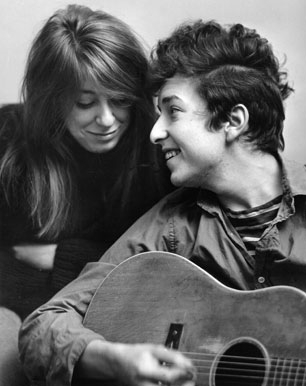
Suze Rotolo, Bob Dylan's girlfriend in the early-Sixties, who walked arm-in-arm with the songwriter on the iconic cover of The Freehweelin' Bob Dylan, died  February 24th after a long illness. She was 67.  Rotolo was the muse behind many of Dylan's early love songs, including "Don't Think Twice, It's All Right," "Boots of Spanish Leather" and "Tomorrow Is a Long Time." She was just 17 when they began dating in 1961, shortly after Dylan arrived in New York City. "I once loved a woman, a child I'm told," he wrote in "Don't Think Twice, It's All Right." "I gave her my heart, but she wanted my soul."
In Bob Dylan's 2004 memoir Chronicles Volume One, he describes meeting Rotolo backstage at a concert. "Right from the start I couldn't take my eyes off her," Dylan wrote. "She was the most erotic thing I'd ever seen. She was fair skinned and golden haired, full-blooded Italian. The air was suddenly filled with banana leaves. We started talking and my head started to spin. Cupid's arrow had whistled past my ears before, but this time it hit me in the heart and the weight of it dragged me overboard."
By early 1962, Dylan and Rotolo were living together in a tiny apartment on West 4th Street. Suze came from a staunchly left-wing New York family, and played a huge role in Dylan's political awakening. When they began dating Dylan was largely apolitical and his set consisted mostly of decades-old folk songs. Rotolo took him to CORE (The Congress of Racial Equality) meetings and taught him much about the civil rights movement. "A lot of what I gave him was a look at how the other half lived -- left wing things that he didn't  know," Rotolo told writer David Hajdu in his book Positively 4th Street. "He knew about Woody [Guthrie] and Pete Seeger, but I was working for CORE and went on youth marches for civil rights, and all that was new to him."
Rotolo told Dylan about the brutal 1955 murder of Emmett Till, inspiring Dylan to write his early protest classic "The Death of Emmett Till." "I think it's the best thing I've ever written," Dylan said at the time. "How many nights I stayed up and wrote songs and showed them to [Suze] and asked, 'Is this right? Because I knew her mother was associated with unions, and she was into this equality-freedom thing long before I was. I checked the songs out with her. She would like all the songs."
In the summer of 1962 Rotolo took a long trip to Italy, leaving Dylan alone and heartbroken in New York. During this period he penned "Don't Think Twice, It's All Right," "Boots of Spanish Leather" and "Tomorrow Is A Long Time" -- all bittersweet love songs about Rotolo. She returned in January of 1963, and weeks later Columbus records send photographer Don Hunstein to shoot the cover of The Freehweelin' Bob Dylan. The young couple walked up and down Jones Street for a few minutes while Hunstein snapped shots. "Bob stuck his hands in the pockets of his jeans and leaned into me," Rotolo wrote in her 2009 book A Freewheelin' Time: A Memoir of Greenwich Village in the Sixties. "We walked the length of Jones Street facing West Fourth with Bleecker Street at our backs. In some outtakes it's obvious that we were freezing; certainly Bob was, in that thin jacket. But image was all. As for me, I was never asked to sign a release or paid anything. It never dawned on me to ask."
Dylan's growing fame put enormous strain on their relationship, and she moved into her sister Carla's apartment in August of 1963. "I could no longer cope with all the pressure, gossip, truth and lies that living with Bob entailed," she wrote in her  memoir. "I was unable to find solo ground -- I was on quicksand and very vulnerable." A particularly nasty fight with Suze and her sister Carla was chronicled in Dylan's 1964 song "Ballad in Plain D." "For her parasite sister, I had no respect," Dylan wrote in one of the angriest songs he ever wrote. "Bound by her boredom, her pride had to protect." In a 1985 interview Dylan said releasing the song was wrong. "It wasn't very good," he said. "It was a mistake to record it and I regret it."
By late 1963, Rotolo could no longer ignore the rumors that Joan Baez and Bob Dylan's relationship had become more than professional. They split up for good, though remained friends for a short period afterwards. During Rotolo's trip to Italy in 1962, Rotolo met film editor Enzo Bartoccioli. They married in 1970 and had a son named Luca. She lived in downtown New York her entire life, and worked as a teacher, a painter and a book illustrator.
For years Rotolo refused to discuss Dylan in interviews, but she agreed to be interviewed in Martin Scorsese's 2005 documentary No Direction Home. In 2009 she wrote a memoir entitled A Freewheelin' Time: A Memoir of Greenwich Village in the Sixties.
Andy Greene @'Rolling Stone'

Hank Shocklee - Bomb Squad Mix 005


USDA Approved Monsanto Alfalfa Despite Warnings of New Pathogen Discovered in Genetically Engineered Crops


Just two weeks before the US Department of Agriculture (USDA) fully deregulated Monsanto's Roundup Ready alfalfa, a senior soil scientist alerted the department about a newly discovered, microscopic pathogen found in high concentrations of Roundup Ready corn and soy that researchers believe could be causing infertility in livestock and diseases in crops that could threaten the entire domestic food supply.
Dr. Don Huber, a plant pathologist and retired Purdue University professor, wrote in a letter to the USDA that the pathogen is new to science and appears to significantly impact the health of plants, animals and probably humans.
"For the past 40 years, I have been a scientist in the professional and military agencies that evaluate and prepare for natural and manmade biological threats, including germ warfare and disease outbreaks," Huber wrote in his January 16 letter to USDA Secretary Tom Vilsack. "Based on this experience, I believe the threat we are facing from this pathogen is unique and of a high risk status. In layman's terms, it should be treated as an emergency."
Huber called for an immediate moratorium on approvals of Roundup Ready crops, but on January 27, the USDA fully deregulated Roundup Ready alfalfa after nearly five years of legal battles with farmers and environmental groups. The USDA partially deregulated Roundup Ready sugar beats on February 4.
The pathogen is about the size of a virus and reproduces like a micro-fungal organism. According to Huber, the organism may be the first micro-fungus of its kind ever discovered, and there is evidence that the infectious pathogen causes diseases in both plants and animals, which is very rare...
Continue reading
Mike Ludwig @'Truthout'

Sunday, 27 February 2011


Top 10 Disastrous Policies From The Wisconsin GOP You Haven’t Heard About

Culture Before Politics

Libya: UN Security Council passes sanctions vote

The UN Security Council has voted unanimously to impose sanctions on Muammar Gaddafi's Libyan regime for its attempts to put down an uprising.
They backed an arms embargo and asset freeze while referring Col Gaddafi to the International Criminal Court for alleged crimes against humanity.
US President Barack Obama has said the Libyan leader should step down and leave the country immediately.
Discussions on forming a transitional government are reportedly underway.
Mustafa Abdel-Jalil - who resigned as justice minister in protest against the excessive use of force against demonstrators - said a body comprising military and civilian figures would prepare for elections within three months, Libya's privately-owned Quryna newspaper reported.
Libya's ambassadors to the United States and UN have both reportedly voiced their support for the plan, which was being discussed in the rebel-controlled eastern town of Benghazi.
The UN estimates more than 1,000 people have died as Col Gadddafi's regime attempted to quell the 10-day-old revolt.
The global body's World Food Programme has warned that the food distribution system is "at risk of collapsing" in the North African nation, which is heavily dependent on imports...
@'BBC'

Obama, Clinton: Gadhafi should leave Libya 'now'


How will America handle the fall of its Middle East empire?

Perfect Loosers present Akwaaba Remixed - Megamix!

   Download
It all started one year ago, Akwaaba head dood Benjamin Lebrave met up with the Perfect Loosers in their studio right outside of Paris. He came with a mountain of songs by Ahmed Fofana, Baba Salah and Onyenze. Treasures he'd accumulated on his travels to West Africa. And he met an enthusiastic trio: Waly had been fed Tunisian music since birth, Mast grew up listening to his Congolese step dad's addictive soukous jams. He also ripped walls with Sigisbert Tartanpion, his head filled with the Caribbean sounds of his parents.
At the time, the Perfect Loosers had already made a remix for Angolan kuduro artist Ze Bula, but clearly they were hungry for much more. And it really didn't take much for this impromptu meeting to give birth to yet another project in the Akwaaba constellatioWith such a diverse musical background, connections in the international DJ and club circuit, and the skills to create dancefloor killers and the artwork to go with it, the trio agreed to go a few steps beyond remixing, and piece together a full length compilation where Africa would meet the club.
The concept is to let artists and producers from around the world rethink handpicked, eclectic West African songs. With one rule: staying away from bland, uninspired "world music remixed" releases. Instead tapping into a bubbling scene of up and coming artists, not only receptive but more importantly inspired by music from Africa.
The stems were a mess, the artists had jam-packed schedules of projects, yet month after month, the album took shape. The result is a diverse blend of club aesthetics and African tradition. Not some trendy, artificial music: it is the sum of creations by original artists with deep musical roots. Artists from Europe and North America - as usual, but also from Africa itself, Latin America and the Middle East. Pushing Akwaaba’s mission further in connecting the dots between artists and music lovers around the world.

What's the Value of a Signature on an Art Print?