Wednesday, 17 February 2010

Basic Channel man launches new reggae reissue label


This week sees the first release on Dug Out, a new reggae reissue label founded by Mark Ernestus and Mark Ainley.
Ernestus is founder of Berlin’s Hardwax record store and, along with Moritz Von Oswald, the man behind Basic Channel, Main Street, Maurizio and Rhythm & Sound. A renowned reggae enthusiast, he co-managed the recent Wackies reissue program, and the excellent Basic Replay series, and through Rhythm & Sound has collaborated with reggae legends like Sugar Minott, Paul St Hilaire and Cornel Campbell.
Ainley is co-owner of Honest Jon’s and another expert in the JA music field. He curated the majority of Soul Jazz’s Studio One series, as well Blood And Fire’s Darker Than Blue compilation. In addition to operating Honest Jon’s eponymous label, he has managed the fantastic PK and (with Ernestus) Basic Replay imprints.
Dug Out will be dedicated to high-quality vinyl reissues, with special focus on the digital era (though they will touch on roots and other reggae genres, and release CDs and downloads). Restoration will be done at Abbey Road Studio; mastering at Dubplates, by co-owner CGB; the records will be manufactured at Pallas.
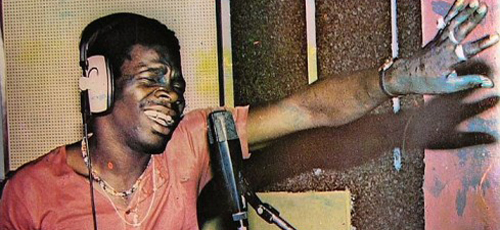
The first Dug Out 12″ is King Kong’s ‘He Was A Friend’. “Originally released in 1988 as a tribute to Tenor Saw,” say the label, “This is the dancehall singer [pictured above] at his most powerful. His grieving, heartfelt vocal is woven through with the haunted quotation of his friend’s finest moments. The rhythm is driving, hard and sombre, with nervous, grubbing synths and ringing claps, and a lethal bass-line. Both vocals come with dubs…a stone classic.”

Un - fugn - believable!!!

By posting this video (which won a Polk Award a couple of days ago) here at this blog, I could face an $11,000 fine!!!
WHY?


"...Because this video was submitted to the Australian Communications and Media Authority (ACMA) who requested a determination from the Classification Board.
Based on the Board's decision, ACMA declared the video to be "prohibited content" under clause 20(1)(b) of Schedule 7 to the Broadcasting Services Act 1992.'  This means that all known links to the video will find their way onto the Internet Filter blacklist...
...This is a crucially important piece of video which will be seen and recognised as such throughout the world, but (officially) not in Australia.  Perhaps we should go out on a limb and praise this instead.  After-all, soon it will be the toughest material we'll be permitted to see.
Our Federal Government must be made to understand the foolishness of their Internet Filter proposal...
"All censorships exist to prevent any one from challenging current conceptions and existing institutions. All progress is initiated by challenging current conceptions, and executed by supplanting existing institutions. Consequently the first condition of progress is the removal of censorships." - George Bernard Shaw (1856 - 1950)
"Censorship reflects a society's lack of confidence in itself." - Potter Stewart (1915 - 1985)
"We are willing enough to praise freedom when she is safely tucked away in the past and cannot be a nuisance. In the present, amidst dangers whose outcome we cannot foresee, we get nervous about her, and admit censorship." - E. M. Forster (1879 - 1970)"
@'iTWire' 

The video was acually blacklisted late last August...

ACMA blacklists Iran protest video

Bernard Fowler & Steve Salas - Little Red Rooster

Addiction researcher hired actors to falsely clear name

BUFFALO, NY (February 16, 2010) 
Attorney General Andrew M. Cuomo today announced criminal charges against a former University at Buffalo researcher who allegedly hired professional actors to portray real people who were familiar with his projects to testify on his behalf during a formal misconduct hearing. The researcher, who was exonerated of the misconduct because of the false testimonies, then attempted to seek $4 million from the state for monetary damages.
“The charges in this case allege a pattern of lies and deceit that a public employee used to attempt to defraud New York’s taxpayers of millions of dollars,” said Attorney General Cuomo. ‘The brazen crimes allegedly committed by this individual outline a series of frauds that could have damaged our outstanding SUNY system. New Yorkers demand and deserve integrity from State employees and with this prosecution we will work to restore that trust in public service.”
In September 2004, William Fals-Stewart, 48, of Eden, was accused of scientific misconduct for allegedly fabricating data in federally funded studies he was undertaking as an employee at the University at Buffalo and Research Institute on Addictions. According to court papers, the allegations were based upon discrepancies between the number of volunteers he reported to the National Institute for Drug Addiction relating to grants for which Fals-Stewart was the Principal Investigator, and the actual number of volunteers who participated in his studies.
According to the felony complaint, during a subsequent formal investigation launched by the University, three witnesses testified by telephone because Fals-Stewart claimed they were out of town. In reality, they were actors who thought they were taking part in a mock-trial. Fals-Stewart paid the actors to testify. He also provided them with scripts to use during the proceedings that were riddled with inaccuracies regarding his research. Fals-Stewart told the three actors, who he had hired before for legitimate training videos, that they would be performing in a mock trial training exercise. They were not aware that they were testifying at a real administrative hearing, nor did they know they were impersonating real people. Because of these false testimonies, Fals-Stewart was exonerated at the administrative hearing.
Claiming that the misconduct allegations tarnished his reputation, Fals-Stewart sued the University, seeking $4 million from the state in damages. The Office of the Attorney General, in its role of defending the University and the state in the court action, conducted a thorough investigation of the claims against the University. It was during this investigation that Cuomo’s office discovered the alleged fraud, forced Fals-Stewart to withdraw his lawsuit and initiated a criminal investigation.
Fals-Stewart was arrested today and charged in Buffalo City Court with Attempted Grand Larceny in the First Degree (class C felony); three counts of Perjury in the First Degree (class D felony); three counts of Identity Theft in the First Degree (class D felony); two counts of Offering a False Instrument for Filing in the First Degree (class E felony); and three counts of Falsifying Business Records in the First Degree (class E felony). The maximum permissible sentence for a class C felony is 15 years in prison.
Attorney General Cuomo thanked Dr. Nancy L. Zimpher, Chancellor of the State University of New York and her staff for assisting in the investigation.
The criminal case is being prosecuted by Assistant Attorney General-in-Charge of the Buffalo Regional Office Russell T. Ippolito, Jr. under the supervision of Deputy Attorney General for Regional Affairs J. David Sampson and Deputy Bureau Chief of the Criminal Prosecutions Bureau Richard Ernst. The investigation was handled by Investigator Paul R. Scherf under the supervision of Deputy Chief Investigator James Domres.
The charges against Fals-Stewart are merely accusations, and the defendant is presumed innocent until and unless proven guilty.

Dubai murder: fake identities, disguised faces and a clinical assassination

Seven of the 11 suspects wanted by Dubai police for the murder of 
Hamas official Mahmoud al-Mabhouh.
Images released by the authorities in Dubai showing seven of the 11 suspects wanted in connection with the killing of Mahmoud al-Mabhouh. Photograph: AP
As soon as Mahmoud al-Mabhouh walked out into the foyer of Dubai International Airport at 3:17pm, the foreign assassins had latched on to his tail.
Within five hours, the Palestinian militant would be dead, the apparent victim of a sophisticated team of killers dispatched to end his life in what officials in Dubai have suggested is an extraordinary tale of modern-day espionage.
Mabhouh was so closely shadowed that, within seconds of passing immigration control, he was forced to manoeuvre his baggage trolley around one of his would-be assassins, a man in a white baseball cap and T-shirt talking casually on a mobile phone.
Tonight Dubai confirmed it had instigated an international manhunt after law enforcement officials issued formal arrest warrants for 11 individuals accused of the "premeditated murder" of Mabhouh, 49, a senior figure from the militant group Hamas, in a case that could have a profound impact on Middle East diplomacy.
Hamas has blamed the Israeli foreign intelligence agency the Mossad for the killing and reports emerged tonight that at least three of the European identities used by the killers were stolen from Britons living in Israel. Israel has refused to comment on the allegations.
Dubai police said they could not rule out Israel's involvement, and hinted at the involvement of spies. "If the law of the jungle is the system for some countries, in the UAE it is rule of law that governs us, and if leaders of some countries give orders to their intelligence services to kill, this practice is rejected and is a crime in our laws, religion and Islamic traditions," said Lieutenant General Dhahi Khalfan Tamim, Dubai's chief of police.
The allegations were met with some scepticism in Israel, where at least one former high-ranking Mossad official, Rami Yigal, said the operation did not "look professional".
According to the detailed but unverified account given on Monday by Dubai police, the killers began arriving in Dubai shortly after midnight on 19 January. Their movement across the city was captured on CCTV footage, much of it released by the Dubai authorities, along with hotel records and flight data they said supports their allegations.
When Mabhouh arrived in Dubai 15 hours later, police believe his assassins, who were using forged European identities, tracked him to room 230 of the luxury Al-Bustan Rotana hotel, in the heart of the city, killed him, and then departed the country. The entire operation was completed in just 19 hours, they said.
The first two suspected assassins used the names Michael Bodenheimer and James Clarke, and respectively carried German and British passports. They were followed 30 minutes later by the only female member, Gail Folliard, and Kevin Daveron. Both carried Irish passports and arrived on a flight from Paris.
The pair were said to have taken separate taxis to the same hotel, in what appears to have been the first in a series of repeated, meticulous decoys and counter-espionage techniques. Throughout their 19 hours in the emirate, members of the gang used cash rather than credit cards for their transactions and almost continuously changed their identities, switching outfits and wearing wigs and glasses as disguises, Dubai police said.
The CCTV footage showed Daveron appeared to have undergone the most extreme transformation, disappearing from the view of a CCTV camera in a hotel lobby as a bald man in a suit, before reappearing with thick black hair and glasses.
Dubai police said the team used international calls to communicate and "special communication devices" to relay encrypted messages. Austria was identified as a possible "command centre" by police, who claimed to have tracked a series of calls to the country from numbers used by the assassins.
By the time Mabhouh arrived in Dubai, all 11 members of the team – including the alleged ringleader, a French passport holder who used the name Peter Elvinger – were in the country and preparing for his murder, police said. They included a man using an Irish passport and the name Evan Dennings, as well as five other British passport holders; Paul John Keely, Stephan Daniel Hodes, Melvyn Adam Mildiner, Jonathan Louis Graham and Michael Lawrence Barney.
Two Palestinians believed to have been involved in the operation are in UAE custody after being handed over by Jordan.
It is still not known why Mabhouh, who was involved in killing two Israeli soldiers during the first Palestinian uprising in 1989 and, according to Hamas, was still active in the Palestinian militant group, travelled to Dubai. Senior Hamas figures have denied reports that the commander was en route to Iran, which is a major Hamas backer.
However, if the evidence presented by Dubai police is believed, Mabhouh's fate was sealed the moment he touched down on UAE territory. After his assassins made an initial sighting at the airport, Dubai police said he was followed to the taxi rank and, later, to the Al-Bustan Rotana hotel.
Footage from the reception desk showed Mabhouh checking in at 3.25pm, as two individuals in tennis outfits – identified by Dubai police as "surveillance" operatives – stood nearby.
As a member of staff showed Mabhouh to his room, the assassins dressed as tennis players quickly followed him into the elevator, in what police said was an attempt to note down his room number. Half an hour later, in another part of the city, it was claimed that Elvinger called Al-Bustan Rotana to book room 237 – which was opposite Mabhouh's room.
Mabhouh returned to his room from a walk around the city at around 8.30pm. He is thought to have been suffocated. Dubai police suggested four assassins may have entered his room while he was out and ambushed him on his return.
Dubai police said all 11 alleged killers flew out of the emirate shortly after. One of the final clips showed Elvinger and Folliard casually leaving the hotel at 8:52pm. She was wearing a stripy sunhat, while his head was hidden beneath a white trilby.

Sa'sha Gr'ey

Preservation Hall Jazz Band

Andrew Bird, Tom Waits, Jim James, Paolo Nutini, and Ani DiFranco are among the diverse artists who joined the Preservation Hall Jazz Band in New Orleans for this album benefiting the group’s time-honored home.
Proceeds from the project — which finds its cast of legendary and contemporary musicians tackling New Orleans classics — go toward Preservation Hall’s music-outreach program and upkeep. Also among the contributors are such established forces as Richie Havens, Dr. John, Pete Seeger, and the Blind Boys of Alabama.

A Call for a Moratorium on Cranky Old Writers Complaining about the Internet

Bizarre UK Tory school plan

[BPSDB]I have been somewhat critical of education policy under the current Government but compared with what the opposition have planned, Labour are sane and clear thinkers.
That’s right. The Tories are planning on taking education advice from a Hollywood actress who has a scheme for controlling aggression by breathing excercises and meditation dreamt up while she was on holiday. I wondered what research backed up her system. Google found me this:
In 2005, leading researcher Kimberly Schonert-Reichl, Associate Professor of Education at University of British Columbia, received a grant from the The Hawn Foundation to conduct a pilot research study on MindUP (TM), developed by the The Hawn Foundation and author Nancy Fischer…The studies used rigorous scientific design, including a randomized control trial, to test the program’s effectiveness. One study also explored the program’s implementation, helping to refine the curriculum design. Ongoing longitudinal studies will evaluate the impact of MindUPTM over time.
Study Results
The studies found that children who participated in MindUPTM, compared to children who did not, showed significant improvements on all four dimensions of teacher-rated school behaviors, including:
Attentional control
Decrease in aggression
Decrease in behavioral dysregulation
Increase in self-esteem
Increase in pro-social behavior such as sharing
Increase in social-emotional competence
Program effects were also found for self-reported optimism, self concept, reflection, and mindful awareness attention. The positive emotional benefits were strongest for girls and/or younger children.
“Rigorous scientific design” sounds good, as do the claimed results. Although the “self-reported” optimism etc. sounds a bit subjective.
The actual research is summarised here.
The research design is described as:
Quasi-experimental, pretest, posttest, control group design
The first study consisted of 246 4th to 7th grade children in 12 classes, 6 classes received the Mindfulness Education (ME) program and 6 control classes did not. The classes were matched for age, ethnicity, gender and social background. The participants filled in questionaires before and after so that changes in social and emotional understading etc. could be assessed.
There is no mention of randomisation, so it would be perfectly possible for the worst performing kids to be assigned to the control groups. Likewise, there is no blinding, so this could influence the researchers interpretation of results.
A series of papers that resulted from this research are listed. All but one are conference presentations ie not peer-reviewed. The remaining one, Promoting optimism and well-being in school-aged children: Initial findings from the “Mindfulness Education” program by K.A. Schonert-Reichl and M.S. Lawler was, as of December 2008, being prepared for publication in Psychology in the Schools.
I had a look on that journal’s website and inputted “Schonert-Reichl” into the author field of the search function. Precisely 0 papers were found.
The second study involved 99 4th and fifth graders assigned to 4 classes, 2 ME and 2 control. This one is a randomised control trial ie the researchers should have no influence over whether a particular student is assigned to an ME or control class. However, we are not told what randomisation technique is used so we do not know whether it was adequate. Furthermore, once more no mention of blinding is made, so when the researchers are assessing the results they will know whether a kid was in the conrol or ME group. The results of this study are still being written up for publication.
There is thus no peer-reviewed evidence and indeed no sound science at all supporting this program.


...and yes that reference is to Goldie Hawn!!!

Tuesday, 16 February 2010

No New York

Ladies and gentlemen, for your listening pleasure, No New York.


No New York (Antilles)
1. Dish It Out (Contortions)
2. Flip Your Face (Contortions)
3. Jaded (Contortions)
4. I Can't Stand Myself (Contortions)
5. Burning Rubber (Teenage Jesus and the Jerks)
6. The Closet (Teenage Jesus and the Jerks)
7. Red Alert (Teenage Jesus and the Jerks)
8. I Woke Up Dreaming (Teenage Jesus and the Jerks)
9. Helen Forsdale (Mars)
10. Hairwaves (Mars)
11. Tunnel (Mars)
12. Puerto Rican Ghost (Mars)
13. Egomaniac's Kiss (DNA)
14. Lionel (DNA)
15. Not Moving (DNA)
16. Size (DNA)

Rapists in Iran's regime

Frankincense: Could it be a cure for cancer?

The gift given by the wise men to the baby Jesus probably came across the deserts from Oman. The BBC's Jeremy Howell visits the country to ask whether a commodity that was once worth its weight in gold could be reborn as a treatment for cancer.
Oman's Land of Frankincense is an 11-hour drive southwards from the capital, Muscat.
Most of the journey is through Arabia's Empty Quarter - hundreds of kilometres of flat, dun-coloured desert. Just when you are starting to think this is the only scenery you will ever see again, the Dhofar mountains appear in the distance.
Map of Oman
On the other side are green valleys, with cows grazing in them. The Dhofar region catches the tail-end of India's summer monsoons, and they make this the most verdant place on the Arabian peninsula.
Warm winters and showery summers are the perfect conditions for the Boswellia sacra tree to produce the sap called frankincense. These trees grow wild in Dhofar. A tour guide, Mohammed Al-Shahri took me to Wadi Dawkah, a valley 20 km inland from the main city of Salalah, to see a forest of them.
"The records show that frankincense was produced here as far back as 7,000 BC," he says. He produces an army knife. He used to be a member of the Sultan's Special Forces. With a practised flick, he cuts a strip of bark from the trunk of one of the Boswellia sacra trees. Pinpricks of milky-white sap appear on the wood and, very slowly, start to ooze out.
Boswellia sacra
Boswellia sacra produces the highest-quality frankincense
"This is the first cut. But you don't gather this sap," he says. "It releases whatever impurities are in the wood. The farmers return after two or three weeks and make a second, and a third, cut. Then the sap comes out yellow, or bright green, or brown or even black. They take this."
Shortly afterwards, a frankincense farmer arrives in a pick-up truck. He is white-bearded, wearing a brown thobe and the traditional Omani, paisley-patterned turban.
He is 67-year-old Salem Mohammed from the Gidad family. Most of the Boswellia sacra trees grow on public land, but custom dictates that each forest is given to one of the local families to farm, and Wadi Dawkah is his turf.
Camel train
He has an old, black, iron chisel with which he gouges out clumps of dried frankincense.
"We learnt about frankincense from our forefathers and they learnt it from theirs" he says. "The practice has been passed down through the generations. We exported the frankincense, and that's how the families in Dhofar made their livings."
Salem Mohammed
Salem Mohammed: Young people prefer careers in oil or government
And what an export trade it was. Frankincense was sent by camel train to Egypt, and from there to Europe. It was shipped from the ancient port of Sumharan to Persia, India and China. Religions adopted frankincense as a burnt offering.
That is why, according to Matthew's Gospel in the Bible, the Wise Men brought it as a gift to the infant Jesus. Gold: for a king. Frankincense: for God. Myrrh: to embalm Jesus' body after death.
The Roman Empire coveted the frankincense trade. In the first century BCE, Augustus Caesar sent 10,000 troops to invade what the Romans called Arabia Felix to find the source of frankincense and to control its production. The legions, marching from Yemen, were driven back by the heat and the aridity of the desert. They never found their Eldorado.
Oman's frankincense trade went into decline three centuries ago, when Portugal fought Oman for dominance of the sea routes in the Indian and the Pacific Oceans.
The Haffa souk in Salalah
Salalah's Haffa souk: The place to buy Omani brands such as Royal Hougari
Nowadays, hardly any Omani frankincense is exported. Partly, this is because bulk buyers, such as the Roman Catholic Church, buy cheaper Somalian varieties. Partly, it is because Omanis now produce so little.
"Years ago, 20 families farmed frankincense in this area," says Salem Mohammed Gidad. "But the younger generation can get well-paid jobs in the government and the oil companies, with pensions. Now, only three people still produce frankincense around here. The trade is really, really tiny!"
Cancer hope
But immunologist Mahmoud Suhail is hoping to open a new chapter in the history of frankincense.
Scientists have observed that there is some agent within frankincense which stops cancer spreading, and which induces cancerous cells to close themselves down. He is trying to find out what this is.
Giant censer in cathedral of Santiago di Compostela
The Catholic church mostly buys Somalian frankincense
"Cancer starts when the DNA code within the cell's nucleus becomes corrupted," he says. "It seems frankincense has a re-set function. It can tell the cell what the right DNA code should be.
"Frankincense separates the 'brain' of the cancerous cell - the nucleus - from the 'body' - the cytoplasm, and closes down the nucleus to stop it reproducing corrupted DNA codes."
Working with frankincense could revolutionise the treatment of cancer. Currently, with chemotherapy, doctors blast the area around a tumour to kill the cancer, but that also kills healthy cells, and weakens the patient. Treatment with frankincense could eradicate the cancerous cells alone and let the others live.
The task now is to isolate the agent within frankincense which, apparently, works this wonder. Some ingredients of frankincense are allergenic, so you cannot give a patient the whole thing.
FRANKINCENSE FACTS
Boswellia sacra grows in Oman, Yemen and Somalia
Other Boswellia species grow in Africa and India
The tree may have been named after John Boswell, the uncle of Samuel Johnson's biographer
In ancient Egypt frankincense was thought to be sweat of the gods
Source: The Pharmaceutical Journal
Dr Suhail (who is originally from Iraq) has teamed up with medical scientists from the University of Oklahoma for the task.
In his laboratory in Salalah, he extracts the essential oil from locally produced frankincense. Then, he separates the oil into its constituent agents, such as Boswellic acid.
"There are 17 active agents in frankincense essential oil," says Dr Suhail. "We are using a process of elimination. We have cancer sufferers - for example, a horse in South Africa - and we are giving them tiny doses of each agent until we find the one which works."
"Some scientists think Boswellic acid is the key ingredient. But I think this is wrong. Many other essential oils - like oil from sandalwood - contain Boswellic acid, but they don't have this effect on cancer cells. So we are starting afresh."
The trials will take months to conduct and whatever results come out of them will take longer still to be verified. But this is a blink of the eye in the history of frankincense.
Nine thousand years ago, Omanis gathered it and burnt it for its curative and cleansing properties. It could be a key to the medical science of tomorrow.
Anonymous film of Iranian Neda's death earns Polk Award


The unnamed people who captured on video and made public the shooting death of an Iranian protester have been chosen to receive a George Polk Award, the first time the journalism prize has honored work produced anonymously.